

Solar vs Tritium Reflex Sight Carbine: 2026 Optics Guide
What is a solar vs tritium reflex sight carbine setup? It is a comparison of two distinct optical illumination technologies used on modern rifles: passive radioactive tritium decay that glows continuously without batteries, versus active-hybrid solar systems that harvest ambient light and use battery backups.
Choosing the right optic power source can mean the difference between a crisp aiming point and a washed-out reticle when it matters most. For many carbine shooters running red dots in low-light drills, the biggest frustration is dot visibility, not recoil or trigger pull. That is why illumination source matters more than most buyers expect before their first night range session.
Key Takeaways
- Illumination source drives everything: Solar and tritium reflex sights produce the same dot shape but power it through completely different physics, which changes when each one works.
- Tritium is always on: Radioactive decay produces a constant glow with zero battery dependency, making tritium reliable in total darkness.
- Solar needs light to work: Solar-assisted sights harvest ambient light to power the emitter, so they can dim or fail in dark environments without a battery backup.
- Carbine mounting matters: Both sight types sit on standardized footprints like RMR, so swapping between platforms is straightforward.
- Budget shapes the choice: Solar-equipped options like the AZV PCO-S start at $239.99; tritium-based sights typically run higher due to the sealed gas capsule.
A carbine reflex sight is a non-magnifying optic that projects an illuminated aiming point onto a partially reflective lens. The shooter sees the dot superimposed on the target without needing to align front and rear sights. Fast acquisition is the whole point.
Where solar and tritium sights split is at the light source. Tritium glows through radioactive decay of a sealed hydrogen isotope capsule — no batteries, no ambient light required, just a steady phosphor-green or orange glow 24 hours a day. Solar sights harvest ambient light through a photovoltaic cell to power the LED emitter, which means they perform brilliantly outdoors but can struggle in a dark hallway or overcast indoor range without a battery assist.
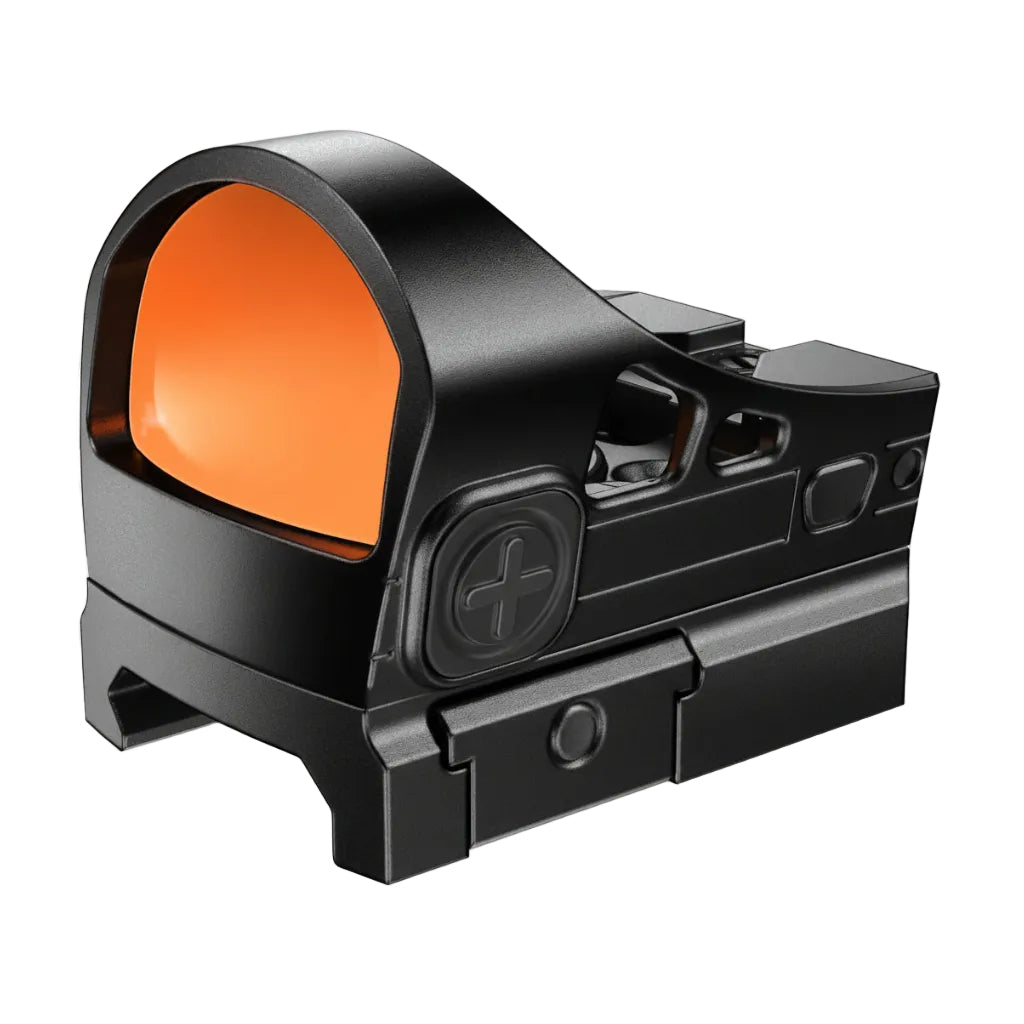
On a carbine specifically, both types mount to standardized footprints. The AZV PCO-S, for example, sits on an RMR footprint and fits most factory-cut slides and Picatinny rail adapters straight out of the box. The footprint compatibility is the same regardless of illumination type.
According to NRA Blog, understanding the illumination method behind a reflex sight is the first decision point before any other spec comparison. Get that wrong and no amount of glass quality fixes it downrange.
Understanding the basic mechanics is only the first step; the real divergence happens when we look at how these power sources age over time.
Passive Tritium Decay vs. Active-Hybrid Solar Systems
Tritium gives you roughly 10 to 12 years before its half-life cuts brightness in half — after that, the glow you paid a premium for is functionally gone. A solar-plus-battery hybrid system, by contrast, can run indefinitely as long as you swap a CR2032 every 18 months or so and keep the solar cell clean.
The Math Behind Tritium Dimming
Tritium is a radioactive isotope with a half-life of approximately 12.3 years. Tritium glows through radioactive decay, with a half-life of about 12 years, so a tritium reticle loses roughly half its brightness over a decade and is generally considered due for replacement.
That is not a gradual fade you adapt to. Pull a tritium optic out of a safe after a decade and you will notice the dot is dim enough to wash out against a bright target background.
How Active-Hybrid Systems Change the Equation
Active-hybrid optics combine a solar cell with a battery backup. Your optic relies on ambient light when available, saving battery life for when it is truly needed. The solar cell handles daylight shooting; the CR2032 takes over in low light or indoors.
The AZV QSO-S Solar Red Dot Sight for Rifle at $129.99 runs exactly this architecture. The solar panel extends battery intervals significantly, and when the cell eventually degrades after years of UV exposure, a standard CR2032 keeps the dot alive. You are never locked into a decay clock you cannot reset. If you want to eliminate battery anxiety entirely, explore the Accufire QSO-S solar reflex line designed for continuous hybrid performance.

According to Meprolight's technical comparison, ambient-assisted illumination systems maintain consistent brightness across conditions in ways passive isotope-based systems physically cannot once decay sets in.
| Factor | Tritium | Solar-Hybrid (e.g., AZV QSO-S) |
|---|---|---|
| Usable lifespan | 10–12 years before significant dimming | Indefinite with periodic CR2032 replacement |
| Brightness over time | Permanent, irreversible decay | Consistent; user-serviceable |
| Battery dependency | None (passive) | Low (solar offsets draw) |
| Cost to restore brightness | Full optic replacement | Under $5 battery swap |
The Safe-Queen Problem
Tritium decays whether the optic is mounted or sitting in a case. A $300 tritium reflex sight stored for 12 years is a $300 paperweight with a barely visible dot. The isotope does not pause for storage.
Solar-hybrid designs sidestep this entirely. No ambient light reaches the cell in a case, so the battery handles standby draw — and the Shake Awake feature on the QSO-S cuts that draw to near zero when the optic is stationary for four minutes. Pull it out in 2036 and it still works.
While long-term decay is a slow issue, shooters face a much more immediate problem when introducing modern weapon lights into the mix.
The High-Lumen Washout Reality in CQB
Tritium reticles fail in CQB weapon-light environments because their output is fixed. A tritium vial glows at roughly 1–3 millicandela regardless of ambient conditions. The moment you activate a 1,000+ lumen weapon light against a white interior wall, the reflected light flooding back through your optic overwhelms that fixed glow completely.
The reflected ambient light hitting your lens is orders of magnitude brighter than the tritium dot behind it. Your eye sees the wall, not the reticle.
Under a bright weapon light, a tritium reticle can wash out against the brighter ambient light, leaving it hard to see at the moment you need it. It is not a technique problem. It is a physics problem.
The fix is an emitter that scales with the environment. Auto-adjusting solar and LED emitters read ambient light levels and push the dot brighter automatically. Shine your weapon light against a white wall and the dot gets brighter in response, keeping your aiming point visible without any manual dial adjustment mid-drill.
Fixed-intensity tritium has no such feedback loop. You can crank a manual brightness dial if your optic has one, but that requires a deliberate action during a moment when your hands are already occupied managing a carbine in a confined space.
According to Meprolight's technical comparison of tritium vs. ambient-reactive sighting systems, fiber optic and solar-assisted emitters consistently outperform fixed-isotope sources in high-ambient-light conditions — exactly the scenario a weapon light creates.
The AZV PCO-S with Solar, for example, pairs a solar cell with a CR2032 backup so the emitter is always drawing from whichever source is stronger at that moment. In a bright-wash CQB environment, the solar cell takes over and pushes output up. The dot stays on your target.
Tritium works well in true darkness with no weapon light. Add a modern 1,000-lumen torch to that equation and the reticle you paid for is gone.
Beyond illumination physics, the technology powering your dot also dictates the physical footprint and heft of the optic itself.
Carbine Weight and Modularity: Glass vs. Micro Red Dots
Illumination technology directly determines how much glass and housing an optic needs. Tritium prism sights require a sealed, pressurized body to contain the radioactive gas vials, which adds significant bulk. Modern solar-assisted micro red dots shed that housing requirement entirely, which is why the AZV PCO-m checks in at just 30 grams.
At 30 grams, you get a full sight picture without adding top-heavy bulk to your carbine. A tritium prism running comparable brightness can weigh 200–350 grams. That difference is felt immediately during target transitions.
A carbine that starts sluggish in the hands only gets worse over a long patrol or extended range session. Every ounce above the receiver rail compounds during muzzle movement between targets.
Where Top-Heaviness Hurts You
The problem shows up during transitions, not static shooting. When your optic sits high and heavy, the rifle wants to tip forward at the muzzle during lateral swings. You fight the optic instead of the target.
Micro solar sights mount low, keep the center of gravity close to the bore axis, and let the rifle move where you point it. The NRA Blog notes that open reflex designs reduce both weight and visual obstruction compared to enclosed prism alternatives.
Modularity on the Carbine Rail
The AZV PCO-S Reflex Red Dot Sight With Solar ($239.99) sits on an RMR footprint and ships with a Picatinny rail attachment. That means one optic covers a factory-cut slide, a carbine rail, or a dedicated mount without buying extra hardware.

Tritium prisms typically require dedicated rings or proprietary mounts. Swapping platforms costs time and money. A micro solar sight with a standard footprint moves between hosts in under two minutes.
If your carbine is already running a light, a sling, and a foregrip, the last thing it needs is a 300-gram optic on top. Keep the glass light, keep the transitions fast.
With weight and washout addressed, the final question usually comes down to long-term survival and standby endurance.
Do Solar Reflex Sights Really Outlast Tritium?
Yes, a well-designed solar-assisted optic can outlast a tritium sight in practical service life — but the reason is less about the solar panel and more about how modern sleep timers protect the battery underneath it.
Tritium has a physical half-life of roughly 12 years. After that, your dot is half as bright as it started. There is no fix, no swap, no reset. The decay is baked into the physics, and Dueck Defense notes that real-world brightness loss becomes noticeable well before the 12-year mark in low-light conditions.
A solar optic running a CR2032 with a four-minute auto-sleep timer tells a different story. That sleep timer means the battery sits in standby for months while the rifle is in the safe. When you pick the carbine up, shake-awake fires the dot before the rifle reaches your shoulder. Battery life stretches to years of range-day use — and when it finally sags, you swap it in seconds.
The top-load battery tray on the AZV QSO-S Solar Red Dot ($129.99) is worth mentioning here. You pull the carbine from storage, notice the battery indicator is low, and replace the CR2032 without removing the optic or touching your zero. That is a two-minute fix at the kitchen table.
The home-defense anxiety question is real: you grab the carbine at 2 a.m. and wonder if the dot is alive. With a tritium sight, that anxiety never fully goes away because brightness is always declining. With a solar-hybrid running shake-awake, the dot lights up the moment the rifle moves. The four-minute sleep timeout preserves battery life across years of safe storage, so the dot is on before you've even confirmed your grip.
NRA Blog points out that battery-dependent sights have historically carried reliability concerns — but that was before sleep timers and shake-awake became standard. The engineering has caught up to the concern.
Tritium wins in one narrow scenario: total darkness with a completely dead battery and no time to swap. Outside that edge case, a solar-hybrid with a healthy CR2032 and a sleep timer is the more dependable long-term choice on a home-defense carbine.
Conclusion: Choosing the Right Carbine Optic
For most shooters in 2026, the solar vs tritium reflex sight carbine debate heavily favors active-hybrid systems. You get adjustable brightness, years of battery life, and no radioactive decay clock ticking down your dot intensity. Tritium earns its place on dedicated duty rifles where you genuinely cannot afford a dead battery at 0300, but that is a narrow use case. Most range-day and home-defense shooters never operate in conditions dark enough to justify tritium's fixed-brightness trade-offs.
The solar panel on a sight like the QSO-S keeps the dot alive through a full range session without touching a brightness button. That kind of hands-off reliability matters when you are running drills.
Last Updated: April 2026
Why Trust This Guide
This guide is maintained by the Accufire Editorial Team.