

Solar vs Battery Red Dot Sights: 2026 Power & Reliability Guide
When choosing between solar vs battery red dot sights, shooters often misunderstand how the power systems actually interact.
In 2026, modern emitter efficiency has fundamentally changed this debate. With features like Shake Awake extending standard battery life to tens of thousands of hours, the necessity of a solar failsafe is heavily dependent on your specific environment.
What Is the Difference Between Solar and Battery Red Dot Sights?
We may earn a commission from links on this page. This doesn't affect our editorial independence — all opinions are our own.
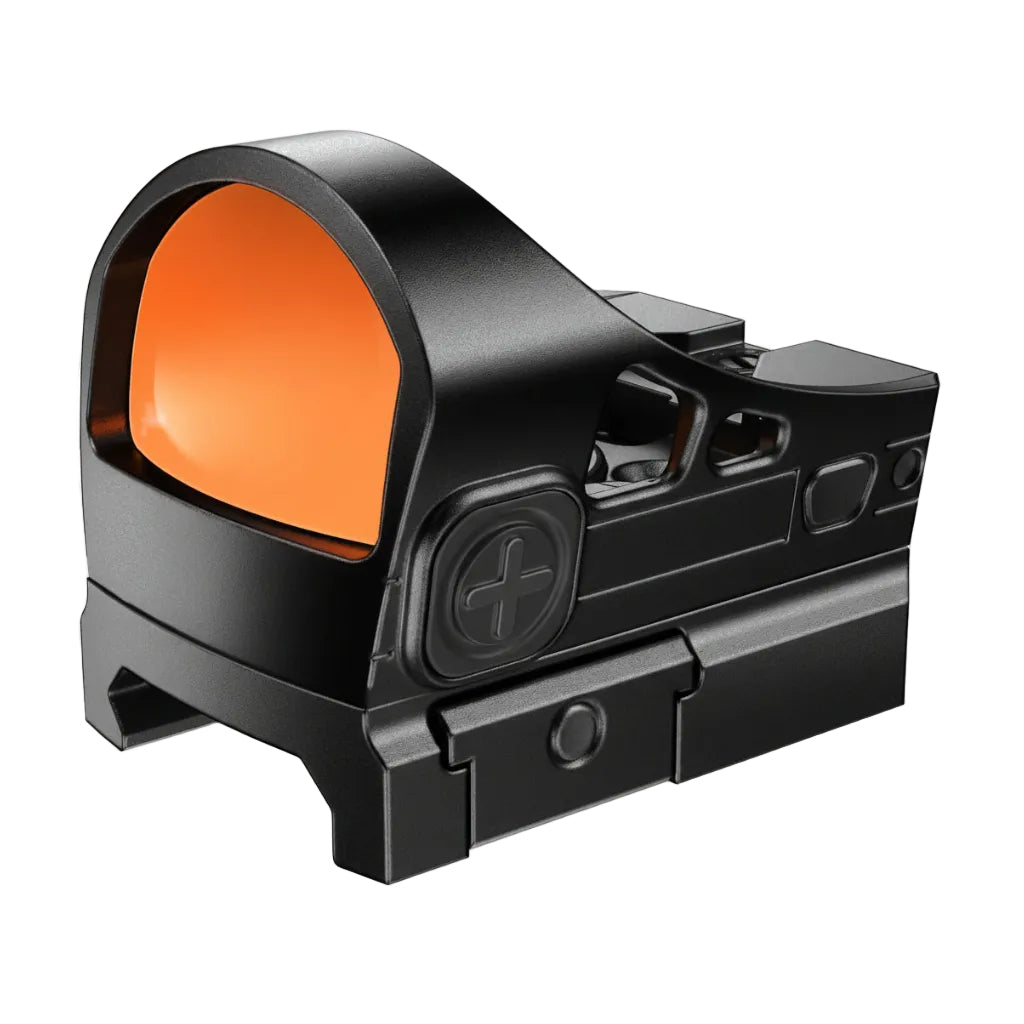
The short answer is this: a solar red dot adds a photovoltaic panel on top of the housing that harvests ambient light to power the reticle, while a standard battery-only sight runs entirely off a dedicated cell — typically a CR2032 — with no backup energy source at all.
Key Takeaways
- Power source: Battery-only sights depend entirely on a CR2032 cell; solar models add a panel that extends run time by harvesting ambient light.
- Solar is a supplement: Every solar red dot still carries a physical battery — the panel reduces drain, it does not replace the cell.
- Battery life gap: Solar-assisted sights can stretch effective run time significantly in outdoor conditions where light is available.
- Indoor/low-light limits: Solar panels produce little or nothing in dim environments, so battery quality still matters regardless of which type you choose.
- Price difference: Solar integration adds cost — compare the standard QSO at $119.99 versus the solar-equipped QSO-S at $129.99 for a real-world example of the premium involved.
At the hardware level, a battery-only sight like the QSO runs on a single CR2032 rated up to 20,000 hours at moderate brightness settings. That number sounds bulletproof until you leave the optic on high brightness for a week straight or store the firearm for six months and come back to a dead cell.
A solar-assisted model adds a small panel integrated into the top of the housing. That panel feeds charge back into the system while ambient light is available, reducing how hard the battery works. The CR2032 is still present — it is not removed or replaced by the panel. Think of the solar component as a failsafe that slows the drain rather than a standalone power source.
A common optic failure is a drained battery on a gun that sat in a safe for months. Solar integration directly addresses that scenario for shooters who train outdoors regularly. It does almost nothing for the shooter running drills inside a dim indoor range.
The practical hardware difference comes down to one question: where does your gun live between uses, and how much natural light does it see? That answer drives everything else in this comparison.
Understanding the physical differences is only half the battle; the real confusion lies in how the optic decides which power source to use.
How Does Solar-to-Battery Power Switching Actually Work?
The solar panel does not recharge the CR2032 battery. It bypasses it. When ambient light hits the photovoltaic cell, the sight draws power directly from that circuit and leaves the battery alone entirely.
This is the part most buyers get wrong. They assume the solar panel is topping off the battery like a trickle charger on a truck. It isn't. The CR2032 is a primary (non-rechargeable) lithium cell, and feeding voltage back into it would be a fire risk, not a feature.
What the bypass circuit actually does is route solar-generated current straight to the LED emitter during daylight. The battery sits idle. No drain. When light drops below the panel's threshold — overcast conditions, indoor ranges, low-angle winter sun — the sight switches back to battery power automatically.
Solar-assisted sights extend effective battery life primarily by reducing the hours the battery is actually doing work, not by storing solar energy for later use.
Think of it as two separate power lanes running in parallel. Solar is the preferred lane in good light. Battery is the fallback. The switching happens passively — no button, no menu, no user input required.
The practical implication: a solar-equipped sight like the PCO-S ($239.99) can go significantly longer between battery swaps if you shoot outdoors regularly, because the battery simply isn't being drawn down during those sessions. But take that same optic into a dim indoor range or a shaded vehicle, and you're running on battery the same as any standard sight.
Some shooters assume their solar dot is "self-sustaining" and skip battery checks entirely. That's how you end up with a dead optic. Keep a fresh CR2032 in the gun bag regardless. The solar circuit is a supplement, not a replacement.
Beyond the internal circuitry, adding a photovoltaic panel introduces physical changes to the optic's footprint and price tag.
Solar vs Battery Red Dot Weight and Cost Comparison
Adding solar to a red dot costs you roughly $40 and a small but real weight penalty — and on a concealed carry pistol, both numbers matter more than people admit.
The PCO Mini sits at 30g and $180. That 30g baseline keeps your slide cycling reliably without the added mass of a solar housing. Move up to the PCO-S with solar and you're at $240 — a $60 jump — plus the extra grams the solar panel housing adds to the frame.
| Model | Solar | Price | Weight |
|---|---|---|---|
| QSO (rifle) | No | $120 | — |
| QSO-S (rifle) | Yes | $130 | — |
| PCO Mini | No | $180 | 30g |
| PCO (handgun) | No | $200 | — |
| PCO-S with Solar | Yes | $240 | 0.28 lb (~127g) |
On a rifle, the solar premium is almost trivial — $10 separates the QSO from the QSO-S. That's a no-brainer if you shoot outdoors regularly. The rifle isn't riding against your hip all day, so the weight delta is a non-issue.
Pistol is a different conversation. The PCO-S with solar runs 0.28 lb (~127g). For a carry gun, extra weight on the slide affects felt recoil and holster fit. It's not dramatic, but it's real, and you should account for it before you buy.
The cost gap on pistol optics is also steeper. You're paying $40–$60 more for solar assist on a platform that spends most of its life in a dark holster. Solar panels need light to work. A concealed carry gun in a dark appendix holster is not generating any solar charge between the parking lot and the range.
For a dedicated range gun or home-defense carbine that sits in ambient light, the solar premium earns its keep. For everyday carry, the standard battery variant saves you money and keeps the slide lighter.
While the cost and weight penalties are clear, the biggest operational limitation of solar tech becomes obvious the moment you step out of the sun.
Do Solar Red Dots Work at Indoor Shooting Ranges?
Short answer: the solar cell will not power your optic inside most indoor ranges. Typical indoor range lighting — fluorescent tubes, LED panels — does not produce the light intensity that solar cells on red dot sights are designed to harvest. You get the battery, period.
Many shooters realize their solar failsafe is useless indoors. They bought the solar model thinking they had a backup power source at all times. They do not, unless they train outside.
Solar cells on red dot sights are calibrated for direct sunlight or strong ambient outdoor light. Indoor and low-light conditions simply do not generate enough photon energy to keep the solar circuit active, so the battery carries the full load the moment you step inside.
This matters most in two scenarios: indoor range training sessions and home defense. If your defensive pistol lives in a nightstand drawer or a dark safe, the solar panel is doing nothing between uses. The battery is your only power source in both situations.
The good news is that quality solar-assisted sights like the PCO-S ($239.99) include a CR2032 battery alongside the solar panel — the solar cell extends battery life outdoors, it does not replace the battery entirely. Indoors, you are simply running on battery like any standard optic.
The practical takeaway: if most of your shooting happens at an indoor range or your primary use case is home defense, the solar feature adds cost without adding meaningful benefit. Factor that into your buying decision before paying the premium.
If solar panels fail to provide a tactical advantage indoors, we have to look at how modern battery technology compensates for that limitation.
Why Modern Battery Features Make Solar Failsafes Optional
If your optic has Shake Awake and a top-loading battery compartment, solar backup is a nice-to-have — not a requirement. The two features that historically made solar attractive (short battery life and zero-loss battery swaps) are both solved problems on current battery-only sights.
Here is how each feature closes the gap:
-
Shake Awake extends battery life to years, not months.
The 4-minute static timeout on the PCO-B means the optic is almost never drawing full power during storage or downtime. Paired with a 50,000-hour baseline battery rating, you are realistically looking at years of service from a single CR2032. Solar adds complexity to solve a problem that Shake Awake already handles.
-
Top-loading batteries eliminate the zero-loss problem.
The biggest real-world argument for solar used to be avoiding the bottom-mounted battery swap — where you pull the optic off the slide, break your zero, and spend range time re-zeroing. Top-loading battery compartments kill that argument entirely. Swap the battery in 30 seconds without touching the mount. Zero stays put.
Shooters can lose significant range time re-zeroing after a battery swap on a bottom-loaded optic. That is a solved problem if you buy the right sight from the start.
-
RMR and RMSc footprint compatibility removes the adapter plate tax.
A battery-only sight that fits 100% of factory-cut RMR and RMSc slides drops straight onto your existing pistol. No adapter plates, no added height, no new zero offset to account for. The PCO-B sits on a standard RMR footprint — most factory slides accept it without modification.
So when does solar still make sense? Honestly, for a rifle optic running extended field time — hunting or a multi-day course where you genuinely cannot predict recharge intervals — solar as a secondary source has merit. For a carry pistol or competition gun that sees regular handling, Shake Awake handles standby power so efficiently that the solar panel is mostly adding weight and $40–$50 to the price tag.
The shooters who struggle with dead optics at the range almost never have Shake Awake sights. They have older battery-only designs with always-on circuitry and bottom-mounted batteries they avoid swapping. Modern battery management has made that a legacy problem.
Conclusion: Which Red Dot Power Source Should You Choose?
Ultimately, the choice between solar and battery-only optics comes down to your primary environment. If you spend days hunting or training in open daylight, a solar-assisted model provides a reliable failsafe that significantly extends your CR2032 lifespan. However, for concealed carry or home defense where the firearm lives in darkness, modern battery-only sights with Shake Awake technology offer everything you need without the added cost.
Before making your final decision, ensure your slide is cut for the correct optic. Check out our educational guides on footprint compatibility, specifically comparing RMR vs RMSc standards, to guarantee a direct fit. If you're looking for examples of the power management tech discussed here, the Accufire PCO and QSO series offer both standard and solar-assisted variants to match your specific operational needs.
It's easy to overthink this choice. Pick the power system that matches where your gun actually lives, not the one that sounds more capable on paper. Check your battery twice a year, run Shake Awake, and go train.
Last reviewed: April 27, 2026
Why Trust This Guide
This guide was assembled by the Accufire Editorial Team. It covers red dot power consumption, solar bypass circuitry, and long-term battery reliability across outdoor and low-light indoor use to provide honest, spec-driven recommendations.
Frequently Asked Questions about Red Dot Power Sources
Does a solar red dot sight work in complete darkness?
No — solar panels require ambient light to generate power. In a dark room, a storage closet, or a night-time defensive scenario, the solar cell contributes nothing. Every solar-assisted red dot on the market — including the PCO-S at $239.99 — includes a CR2032 battery as the primary source precisely for this reason. Think of the solar panel as a battery extender, not a replacement. If your use case includes low-light or indoor work, the battery is doing the real job regardless of which sight you pick.
How long does a CR2032 battery last in a red dot sight?
Battery-only red dots like the QSO advertise up to 20,000 hours on a CR2032 at moderate brightness settings. Real-world life is lower — running max brightness or leaving the sight on continuously shortens that figure considerably. Shake Awake auto-sleep helps significantly; the sight powers down after four minutes of no movement and wakes the moment you pick it up. A CR2032 costs under two dollars and takes two minutes to swap. Carry a spare in your range bag and battery life stops being a meaningful concern.
Is a solar red dot sight worth the extra cost over a battery-only model?
For most shooters, probably not. The PCO-S runs $239.99 versus $199.99 for the standard PCO — a $40 premium for solar assist. If you hunt or shoot outdoors in bright conditions regularly and hate thinking about battery swaps, that $40 buys real peace of mind. If you shoot primarily indoors, compete under artificial lighting, or already use Shake Awake sleep modes, you are paying for a feature that rarely activates. For most shooters, that $40 is better spent on ammunition unless outdoor carry is their primary use case.
Does the solar panel add noticeable weight to a red dot sight?
Minimally. The PCO-S weighs 0.28 lb, which is comparable to battery-only pistol red dots in the same footprint class. The solar cell itself is a thin strip integrated into the housing — it adds grams, not ounces. For a pistol mounted on a carry gun, that difference is imperceptible. On a rifle running a full optic setup with a magnifier, you are unlikely to notice it either. Weight is not a meaningful differentiator between solar and battery-only models at this price tier.
Can a solar red dot charge through a car windshield or window glass?
Reduced, but yes. Standard automotive glass filters UV and reduces overall light transmission. The solar panel will still generate some power in direct sunlight through a windshield, just less efficiently than in open air. For a safe stored in a vehicle — a common setup for home defenders — this means the sight gets partial solar benefit during daylight hours. It is not a substitute for checking your battery periodically, but it does help offset passive drain during storage.
Is Shake Awake technology reliable enough to replace always-on operation?
For most applications, yes. The PCO and QSO series both use a four-minute static timeout with motion-triggered wake — the dot lights up rapidly once the sight moves. Under normal handling, Shake Awake reliably wakes the optic the moment the sight is moved. The edge case is a sight stored motionless in a holster or safe for hours; draw the gun and the dot activates before your sights are on target. For dedicated home defense or duty use where instant-on is non-negotiable, keep the sight on a low brightness setting and swap batteries on a schedule instead.