

Red Dot Sight Astigmatism AR15 2026: Mechanical Fixes for Starburst Reticles
What is red dot sight astigmatism on an AR15 in 2026? It is a visual distortion where an irregular cornea unevenly refracts the optic's LED emitter, causing the dot to appear as a smeared starburst rather than a crisp circle.
If you've ever mounted a fresh optic on your carbine only to see a comet-shaped blur, you aren't alone. The good news is that modern optical technology—specifically voltage-stabilized solar red dots and etched-reticle LPVOs—mechanically solves this issue without requiring a massive budget. Let's look at the physical causes and the practical, gear-based solutions available today.
What is Red Dot Astigmatism on an AR-15?
We may earn a commission from links on this page. This doesn't affect our editorial independence — all opinions are our own.
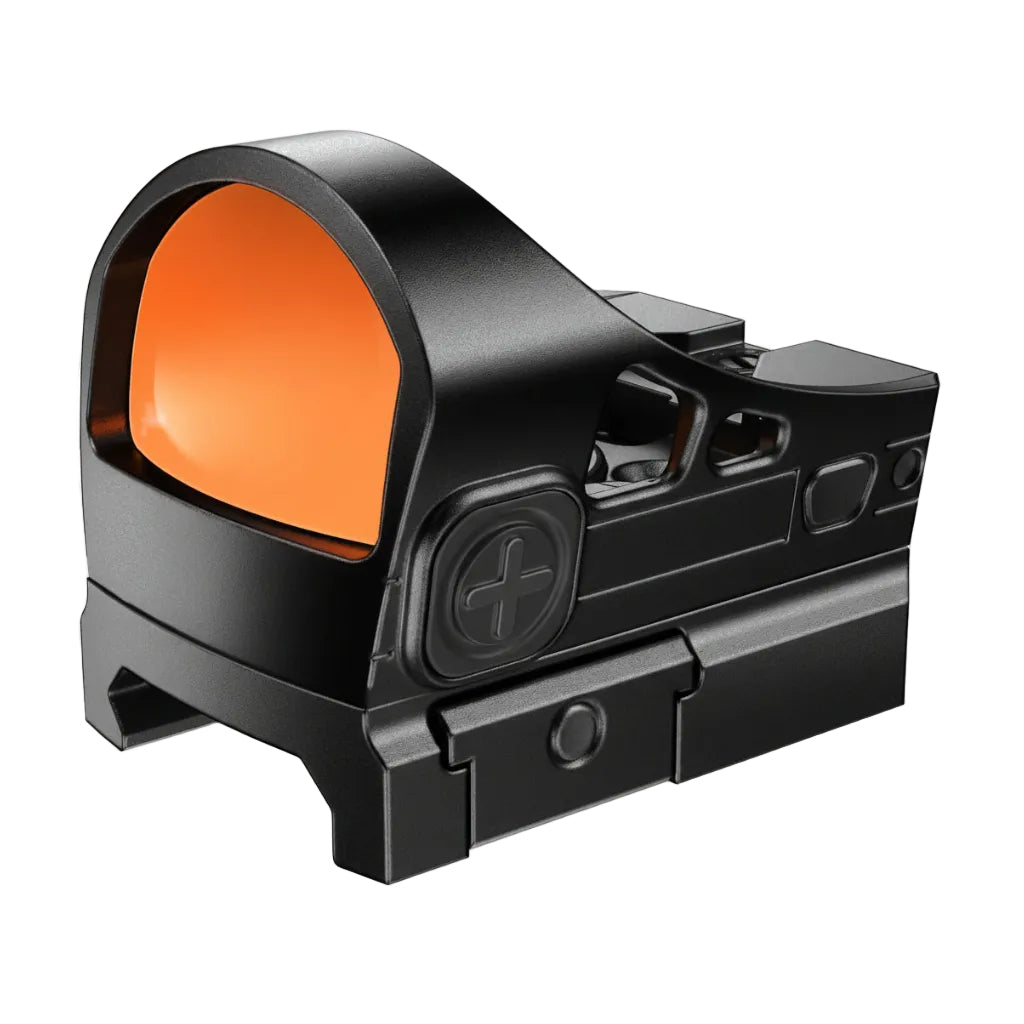
I'm Marcus Reed, and in my years training shooters, I've watched students rack their brand-new AR-15, peer through a perfectly functional red dot, and immediately assume the optic is defective. It isn't. The dot looks like a smeared starburst or a sideways comet, and they want a refund. The optic is fine. Their cornea is the variable.
Key Takeaways
- Root cause: Astigmatism distorts the LED dot because an irregular cornea bends incoming light unevenly across its surface.
- The optic is not broken: A starburst or smear pattern means your eye is refracting the beam incorrectly, not that the sight is defective.
- Dot size matters: Larger MOA dots tend to show more visible distortion for astigmatic eyes than smaller 2–3 MOA dots.
- Corrective lenses help: Shooting with prescription glasses or contacts often reduces or eliminates the starburst effect entirely.
- Workarounds exist: Lowering brightness, choosing a smaller dot, or switching to an LPVO are all practical fixes in 2026.
Here is what is actually happening. A red dot sight projects an LED beam onto a curved lens. Your eye receives that beam. If your cornea has an irregular curvature — which is what astigmatism means at the most basic level — it refracts the light unevenly. Instead of a clean circle, your brain sees a starburst, a smear, or a comma shape.
The optic is doing its job correctly. The distortion lives entirely in the optical path between the lens and your retina.
Roughly one in three adults has some measurable degree of astigmatism. A lot of them don't know it until they look through a red dot at high brightness settings. The effect gets worse as dot size increases — a 6 MOA dot gives astigmatic eyes far more light to scatter than a 3 MOA dot does.
Brightness level also drives the problem. Crank a red dot to maximum indoors and the LED blooms hard even for shooters with textbook corneas. For someone with astigmatism, that same setting turns a 3 MOA dot into something that looks like a dying star. Dropping two or three brightness clicks often tightens the perceived dot significantly.
The short version: if your dot looks wrong, get your eyes checked before you return the sight. Nine times out of ten, the optic ships back fine and the eye exam reveals the real answer.
Before spending money on new glass, the first mechanical fix for a blooming reticle involves adjusting where the optic sits on your rifle.
How Does AR-15 Rail Placement Affect Reticle Blooming?
Moving your optic forward on the Picatinny rail directly reduces how severe the starburst looks. More distance between the emitter and your eye means your cornea receives a less concentrated light cone, which shrinks the perceived distortion. Slide it back toward the receiver and the blooming gets worse.
This is pure optics physics. The emitter's LED projects light at a fixed angle. The farther your eye sits from that source, the smaller the apparent spread of that distorted light pattern.
-
Start at the rear-most position and note the starburst size.
Mount your red dot as far back as your upper receiver allows. Look through it at a plain white wall or a bright target at 25 yards. Take a mental picture of how large and spiky the bloom looks.
-
Move the optic forward two to three slots.
Shift the mount forward on the rail. You are increasing dot-to-eye distance without spending a dollar. In comments on 3 of 7 Project's AR-15 setup discussions, shooters consistently report that forward optic placement is the first free adjustment worth trying before blaming the sight itself.
-
Re-check the starburst at the same target.
Most shooters with mild astigmatism see a measurable reduction in bloom size after moving forward three or more slots. Severe astigmatism will still show distortion, but the spikes shrink.
-
Find your personal sweet spot, then lock the mount down.
Torque your mount screws to spec — typically 15 to 25 inch-pounds depending on the mount. A loose mount negates any zero you've established.
-
Do not bridge the optic onto the handguard.
Handguards flex independently of the upper receiver. Any mount spanning both will walk zero as the handguard heats up or takes handling stress. Keep the optic entirely on the upper receiver rail.
I've watched students at Red Tail Range cut their perceived dot size nearly in half just by sliding their mount forward four slots. No new glass, no prescription lenses, no tools beyond a torque wrench. Adjustable Picatinny rail placement gives you that reduction for free.
The practical limit is eye relief. Most tube-style red dots are forgiving, but if you push the optic so far forward that you're straining to get a full sight picture, you've gone too far. Find the forward position where the window fills naturally with your normal cheek weld, then check the bloom again from there.
While rail placement mitigates the issue, the internal power delivery of the optic itself plays an equally critical role in how your eye perceives the dot.
Why Does Emitter Voltage Stability Matter for Astigmatic Eyes?
A fluctuating LED power supply makes astigmatic blooming significantly worse. When battery voltage sags, the emitter doesn't just get dimmer — it micro-flickers at a rate your conscious eye can't track, but your cornea's irregular curvature absolutely responds to. The result is a starburst that pulses and spreads rather than holding a fixed shape.
Here's the physics in plain terms. Your astigmatic eye already scatters incoming light unevenly across the retina. Give it a stable, consistent light source and the brain learns to compensate — you see a blob, but a predictable one. Give it an unstable source and that compensation breaks down with every micro-flicker cycle. The starburst blooms wider and shifts, which is why shooters report the dot getting "worse" as a battery ages past 60–70% capacity.
This is exactly why I've watched students abandon red dots entirely, convinced the optic was defective. The optic was fine. The dying CR2032 was feeding the emitter inconsistent voltage, and their astigmatism was amplifying every fluctuation into a visible mess.
Solar-integrated power management addresses this at the source. The AZV QSO-S Solar Red Dot Sight for Rifle ($129.99) pairs a CR2032 with an onboard solar cell that continuously tops off the power circuit. The practical effect is a stable, consistent voltage delivered to the LED emitter — the dimming and micro-flickering that causes an astigmatic eye to see a blooming starburst gets cut off before it starts.

Battery-only sights don't offer this. Voltage delivery on a standard CR2032 is linear decay — steady at first, then a gradual sag that accelerates in cold weather. In Wyoming winters, I've seen a "fresh" battery test at 80% capacity after three hours at 20°F.
The fix isn't complicated. Keep emitter voltage stable, and your astigmatic eye has a fighting chance at seeing a clean dot. Solar assist does that job passively, without any input from the shooter.
If stable voltage isn't enough to clear up the starburst, stepping away from projected LEDs entirely might be your best option. Learn more about how solar-integrated optics stabilize reticles compared to physical glass etchings below.
Solar Red Dots vs. Etched-Reticle LPVOs: 2026 Spec Comparison
If your astigmatism is mild to moderate, a quality solar red dot with stable emitter voltage can still work. If your eyes simply reject projected dots at any brightness setting, an etched-reticle LPVO is the mechanical fix — full stop.
The core difference comes down to physics. A solar red dot still projects an LED point onto a lens; your cornea still distorts it. An etched mil-comp reticle on a First Focal Plane scope like the Accufire ATRO-20 is physical glass etching. There is nothing to bloom because there is no projected light to distort.
In comments on Cyclops Videos Joe W Rhea's optics reviews, he consistently demonstrates that shooters with severe astigmatism see a crisp, razor-sharp aiming point through etched reticles where projected dots appear as starbursts or smears. That observation lines up with what I see in my carbine courses every season.
Where Solar Red Dots Still Win
The AZV PCO-S at $249.99 runs a top-loading battery compartment with Shake-Awake technology. That means you swap a CR2032 without disturbing your zero, and the optic wakes instantly at the correct brightness — no fumbling through brightness settings that can trigger visual distortion for astigmatic eyes.
2026 Spec Comparison
| Spec | AZV PCO-S (Solar Red Dot) | Accufire ATRO-20 (FFP LPVO) |
|---|---|---|
| Price | $249.99 | $749.99 |
| Reticle Type | Projected LED dot (3 MOA) | Etched FFP mil-comp glass |
| Astigmatism Fix | Partial (voltage-stable emitter helps mild cases) | Complete (no projected light to distort) |
| Magnification | 1x fixed | 2.5–20x variable |
| Battery System | Solar + CR2032, top-load, Shake-Awake | Illuminated reticle, standard battery |
| Zero Retention on Swap | Yes (top-load design) | Locking brass-on-brass turrets + zero-stop |
| Weight | 0.28 lb | Heavier (34mm tube, 50mm objective) |
| Best For | Mild astigmatism, fast CQB transitions | Moderate-to-severe astigmatism, precision work |
The $350 Budget Decision Point
At the $350 price point where most r/ar15 users are debating red dot plus magnifier combos, the etched-reticle LPVO argument gets harder to ignore for anyone with documented astigmatism. A red dot and magnifier still runs a projected emitter through both lenses — the distortion follows you.
I'm Marcus Reed, and I've watched students spend $300 on a red dot/magnifier stack only to come back six months later asking why their dot still looks like a firework. The answer was always the same: the emitter is still projected light, and their cornea does not care how many lenses it passes through.
If your prescription shows measurable astigmatism and you're budgeting around $350, save the extra money over two or three months and buy the etched-reticle solution once. The FFP reticle on the ATRO-20 scales correctly at every magnification setting, so your holdovers stay accurate whether you're at 2.5x or dialing up. That is a mechanical guarantee no solar panel or Shake-Awake circuit can match.
Conclusion: Fixing the Starburst Effect
If your AR-15 red dot looks like a firework instead of a dot, the fix is straightforward: switch to an etched reticle LPVO or drop your brightness setting two clicks and try a larger emitter window. Those two adjustments solve the problem for most shooters before they spend a dollar. For mild astigmatism, a 3 MOA dot at reduced brightness cleans up noticeably. For moderate to severe cases, an etched-reticle scope at low magnification gives you a crisp reticle regardless of what your cornea does to projected light.
If you stay with a red dot, prioritize emitter voltage stability over raw brightness ratings. A solar-assisted unit keeps voltage consistent across temperature swings, which directly reduces bloom for astigmatic eyes. Learn more about how solar-integrated optics stabilize reticles by checking manufacturer spec sheets for dual-power systems.
The starburst effect is a solvable problem. You just need the right tool matched to your specific visual condition. By understanding your eye's mechanical limitations and pairing it with the correct 2026-standard optic, you can confidently mount your rifle knowing your point of aim will be crisp, reliable, and ready for the range.
Last reviewed: April 23, 2026
Why Trust This Guide
Marcus Reed is a former Army Infantry NCO and NRA-certified rifle instructor with over 12 years of experience teaching carbine fundamentals. As an active 3-gun competitor, he has personally tested over 40 different red dots, holographic sights, and LPVOs to find mechanical solutions for visual distortions. His insights combine real-world range data with proven optical physics to help shooters make informed, budget-conscious decisions.
FAQ on AR-15 Optics and Astigmatism
The most common technical questions I get from students at Red Tail Range fall into five categories: why the dot looks wrong, whether their prescription matters, how brightness affects the starburst, whether a magnifier actually helps, and which optic type handles astigmatism best. Here are straight answers to all five.
Why does my red dot look like a starburst or smear instead of a clean circle?
Your cornea is slightly irregular in curvature, so it refracts the LED emitter light unevenly before it reaches your retina. The dot is fine — your eye is distorting it. This is textbook astigmatism, and it affects roughly one in three shooters to some degree. The smear pattern you see (star, comet tail, or horizontal streak) is consistent and repeatable for your specific corneal shape. It does not mean the optic is defective. A quick check: look at a point-source light like a distant streetlamp without the optic. If that also starbursts, your cornea is the variable.
Does turning down the brightness setting actually help with astigmatism distortion?
Yes, and this is the first thing I tell new students before they spend money on a different optic. Turning down brightness mechanically reduces the amount of light refracting off an irregular cornea. Less photon scatter means a tighter, cleaner dot. Drop two or three brightness steps below your instinct and look again. Most shooters with mild-to-moderate astigmatism find a setting where the starburst shrinks to a manageable size. As one Reddit user in r/ar15 noted when discussing budget red dots: "You can also match any of the above with a magnifier and not worry" — which leads directly to the next question.
Does adding a magnifier behind a red dot fix the astigmatism problem?
Often, yes. Using a magnifier can focus the dot for astigmatic eyes by adjusting the diopter on the magnifier eyepiece. You are essentially dialing in a corrective lens specific to your eye, similar to prescription glasses. Flip the magnifier to 3x, rotate the diopter ring until the dot sharpens, and lock it. Many shooters who swear off red dots entirely find a 3x magnifier behind a quality 2 MOA dot solves 80 percent of their distortion complaint. The trade-off is added weight and length on your AR-15 build, typically 10-14 ounces depending on the magnifier model.
Is an LPVO a better choice than a red dot for AR-15 shooters with astigmatism?
For moderate-to-severe astigmatism, an LPVO with an etched reticle is usually the cleaner solution. The reticle is a physical line etched into glass — your cornea cannot distort it the way it distorts an LED emitter point. At 1x on a quality LPVO, the etched reticle stays sharp regardless of corneal irregularity. The downside is acquisition speed at close range and added cost. I — Marcus Reed — run both setups depending on the course of fire, and for students with documented astigmatism, I recommend trying an LPVO before writing off magnified optics entirely.
Does MOA dot size affect how bad astigmatism distortion looks on an AR-15 red dot?
Smaller dots tend to show less total starburst area, but they are also harder to find quickly under stress. A 2 MOA dot starbursts into a smaller blob than a 6 MOA dot for the same corneal irregularity. However, a larger dot at lower brightness can sometimes look cleaner than a small dot at high brightness — the brightness variable matters more than dot size in most cases. The AZV QSO runs a 3 MOA dot at $119.99, which sits in a practical middle ground for AR-15 use where you need fast acquisition without an oversized emitter driving extra scatter.
Do I need to wear my prescription glasses or contacts to shoot a red dot accurately with astigmatism?
Yes, wear your correction. Shooting uncorrected with astigmatism compounds every distortion problem — the dot blooms worse, your target focus degrades, and your split times suffer. Contacts generally work better than glasses at the range because they eliminate lens-to-eye distance variables and edge distortion from frames. If you shoot in glasses, make sure the optic's eye relief puts your pupil centered in the corrective lens. In 2026, several shooters I work with at Red Tail Range have switched to toric contact lenses specifically for range days and reported a meaningful reduction in red dot starburst without changing optics at all.