

Choosing a Reflex Sight AR-15 Pistol Setup in 2026
Equipping a short-barreled platform requires more than just grabbing the nearest optic off the shelf. Finding the right reflex sight ar-15 pistol setup means balancing violent recoil forces against strict weight limits. What is a reflex sight for an AR-15 pistol? It is a non-magnified, parallax-free electronic optic designed to withstand the sharp recoil impulse of short-barreled platforms while maintaining a lightweight profile that preserves the weapon's center of gravity.
Because these firearms vent gas earlier and cycle harder than standard carbines, they destroy budget red dots with alarming speed. If you want an optic that survives the concussion without making your gun nose-heavy, you have to look closely at housing materials, battery tray orientation, and overall mass.
Key Takeaways
- AR pistols with sub-10-inch barrels generate heavy concussion that shocks optic electronics — pick reflex sights with sealed CR2032 housings and shake-awake circuits, not basic LED dots.
- Optic weight on sub-10-inch uppers shifts balance forward — keep slide-mounted optics under 1.6 oz to maintain natural transitions.
- Top-load battery trays are critical: side-load means re-zeroing every battery swap (every 50,000 hours, but the moment matters in defense scenarios).
- Solar backup matters MORE on a home-defense AR pistol than on rifles, because you may not check the battery for years between actual use cases — the photovoltaic cell auto-tops the dot.
- Co-witnessing your reflex sight with backup iron sights doubles the redundancy at zero added stage time once the transition is trained.
What is an AR-15 Pistol Reflex Sight?
Most shooters assume any red dot will work on an AR-15 pistol. The short-barreled, brace-equipped platform actually punishes standard rifle optics in ways that show up fast at the range.
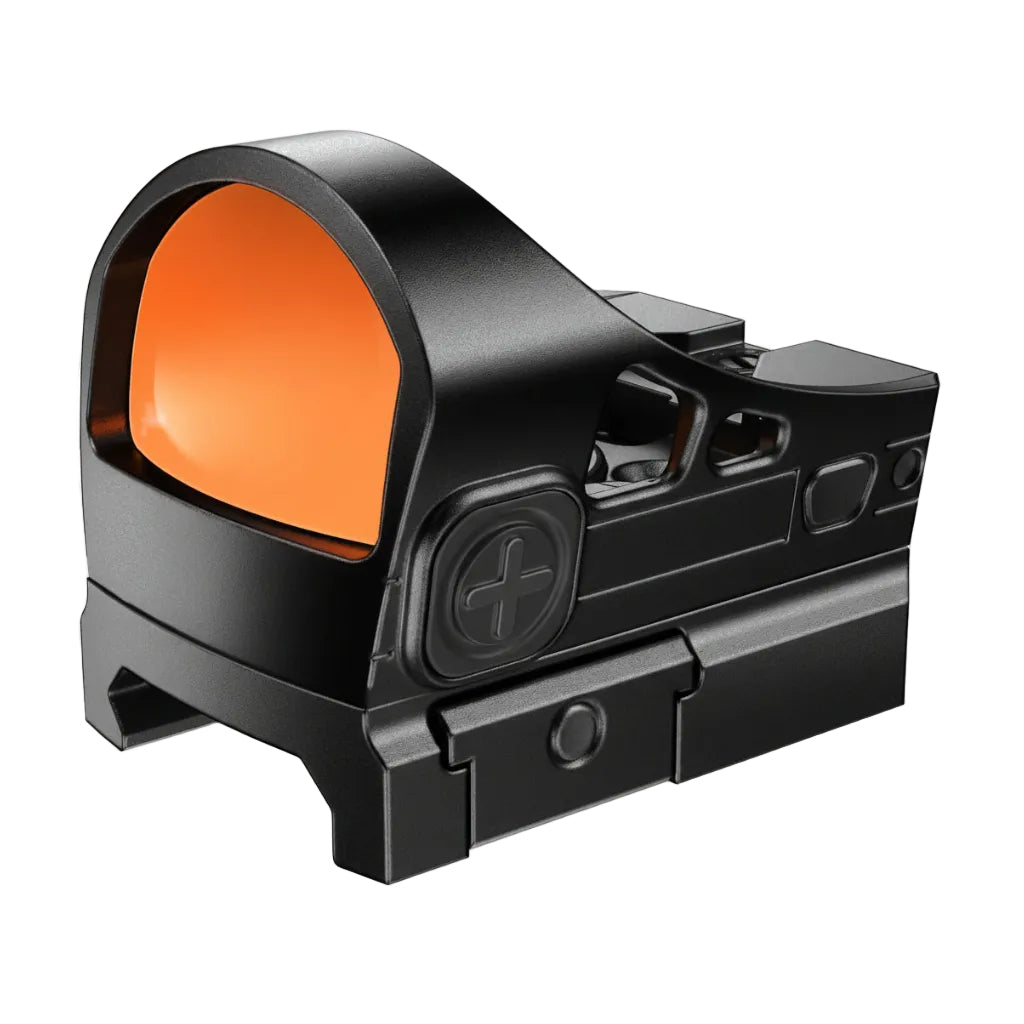
A reflex sight built for the AR-15 pistol runs at 1x magnification with unlimited eye relief. That second spec matters more than most buyers realize: when your brace is collapsed or you're shooting from a compressed position, a fixed eye-box optic simply stops working. Unlimited eye relief means the dot stays visible wherever your eye lands.
The other key difference is parallax-free aiming. Standard rifle scopes have a parallax set point, typically 100 yards, which introduces aiming error when your eye shifts off-axis. A reflex sight eliminates that. You can cant the gun, shoot one-handed, or clear from an awkward angle and the dot still represents your true point of impact.
Footprint compatibility is the third consideration specific to this platform. The AZV PCO series sits on an RMR footprint with a 28×17.5mm window, giving you a wide sight picture on a compact, lightweight body that won't upset the balance of a short-barreled build.
Understanding the basic requirements is only the first step; the real challenge lies in how these optics handle the physical abuse of a short barrel.
The Concussion Problem: Short Barrels vs. Optic Electronics
Short-barreled AR-15 pistols beat optics harder than full-length rifles do. A 7.5-inch barrel vents gas earlier in the cycle, producing a sharper, snappier recoil impulse rather than the slower push you feel on a 16-inch carbine. That difference in dwell time translates directly into g-force spikes at the optic mount.
The internal LED emitter is the first casualty. When the impulse is violent enough, the emitter shifts inside its housing — sometimes by fractions of a millimeter — and your zero walks. Shooters running budget optics on 7.5-inch pistols regularly report dot flicker or zero loss inside 300 rounds.
- Understand dwell time physics. Shorter barrels open the gas port before pressure drops fully. The bolt carrier gets hit with a faster, more aggressive impulse. Every component on the rail absorbs that spike, and thin-walled optic housings flex under it.
- Check housing material before you buy. 7075-T6 aluminum is the spec that matters here. It resists flex under short-dwell recoil, which keeps the emitter seated and your zero repeatable. Housings made from lower-grade alloys or polymer shells can deform subtly over hundreds of rounds.
- Verify shock ratings, not just waterproof ratings. IPX7 waterproofing tells you the optic survives a meter of water for 30 minutes. It says nothing about recoil tolerance. Look for a published shock rating in g-force — optics rated to 1,000g or higher are built for pistol-caliber and short-barrel abuse.
- Torque your mount screws to spec and re-check at 50 rounds. Recoil impulse from a short gas system will back out under-torqued screws faster than you expect. Blue Loctite on mount screws is standard practice for this platform.
- Watch for early warning signs. Dot flickering under recoil usually means the battery contact is loosening, not a dead battery. Zero walking after a range session points to emitter shift or a loose mount. Address both before the next outing.
Emitter survival on short-barreled platforms comes down to the right benchmark: optics rated for pistol slide recoil — which runs higher g-forces than most rifle applications — are the appropriate standard for AR pistol use.
The physics here are straightforward. A 7.5-inch pistol is closer in recoil character to a handgun slide than to a carbine. Buy the optic accordingly, confirm the housing is 7075-T6 aluminum, and check that shock rating before the waterproof spec ever crosses your mind.
Curious about optics built for this level of abuse? See how the PCO series handles heavy recoil.
While surviving the blast is critical, the physical weight of that durable housing introduces a completely different problem for short-barreled builds.
How Optic Weight Alters the Balance of Sub-10-Inch ARs
Optic weight matters more on an AR-15 pistol than a full-size rifle because the barrel is so short that the center of gravity sits much closer to the receiver. Add even a few extra ounces up front and the whole platform tips forward, making target transitions feel like you're swinging a weighted club instead of a nimble short-barrel build.
A full-length 16-inch rifle distributes mass across a longer lever arm. The barrel itself counterbalances a heavier optic. On a 7.5-inch to 10.5-inch barrel, that lever arm shrinks dramatically, so every gram on the rail has an outsized effect on where the gun wants to rest in your hands.
The practical threshold most armorers land on is 30 grams. Stay at or under that number and the pistol maintains a neutral balance point that lets you swing between targets without fighting the gun. Go heavier and you'll feel the muzzle pulling down during transitions, which costs you split-second recovery time.
A high-quality mini reflex sight hits exactly 30g at this price point. That's the upper edge of the acceptable window — light enough to keep the balance point neutral, but still substantial enough to handle the violent recoil impulse a short barrel generates without shifting zero.
Heavier tube-style red dots on short pistol uppers make the difference immediate: the gun feels nose-heavy by the second or third target in a transition drill. A sub-30g mini reflex keeps the balance where the gun swings on its own momentum rather than requiring you to muscle it.
One other factor worth tracking: mounting height. A taller mount shifts the optic's mass higher above the bore axis, which adds a small rotational moment during recoil. On a pistol that already bucks harder than a rifle, keeping the optic as low-profile as possible compounds the benefit of staying under the 30g threshold.
Beyond the external housing and weight, the internal components—specifically how the battery is secured—play a massive role in long-term reliability.
Top-Load vs. Side-Load Battery Trays Under Recoil
Top-load battery trays survive AR pistol concussion better. The tray door sits perpendicular to the recoil impulse, so the repeated rearward shock drives it closed rather than working it loose over a firing session.
Side-load trays take the hit differently. The door hinge runs parallel to the bore axis, which means every round fired applies lateral stress directly to the retention clip. On short-barreled AR pistols generating sharp, high-frequency concussion, that clip fatigues faster than it would on a full-length rifle.
Battery tray failures show up under heavy semi-auto fire, and side-load designs are the most vulnerable on pistol-caliber and short-barrel builds, where the concussion signature is more abrupt than a standard 16-inch carbine.
The zero-shift problem compounds this. If the tray pops even slightly mid-session, you may reinstall the battery and find your point of impact has walked. Getting back to zero costs you time and ammo you may not have at the range.
Our top-load models use a battery compartment which keeps the CR2032 locked in place under sustained fire. Its Shake Awake technology also handles the standby side of the equation: the optic sleeps after 4 minutes of no movement, then wakes instantly when you pick the gun up. That 4-minute timeout is what makes 10,000+ hour battery life realistic in a home-defense role where the gun sits staged for weeks at a time.
Some micro models run a side-load tray on an RMSc footprint. It works fine on sub-compact pistols with lighter recoil. On an AR pistol with a 7-inch or 8-inch barrel, the side-load design is the weaker choice for long-term retention.
| Design | Recoil Stress Direction | AR Pistol Suitability |
|---|---|---|
| Top-load | Drives door closed | Preferred |
| Side-load | Stresses retention clip laterally | Better suited to lighter-recoiling platforms |
Securing the battery is one thing, but ensuring you actually have power when you need it brings us to the debate over redundant energy sources.
Do You Need Solar Backup for a Home Defense AR Pistol?
Yes. For a dedicated home defense AR pistol, solar backup is worth the small price premium. A dead battery at 2 a.m. is not a hypothetical — it happens when a sight sits staged for months between range days, and Shake Awake only helps if the optic had charge to begin with.
Battery-only sights are fine for range guns you check regularly. A home defense build is different. That weapon may sit untouched for six months, and you need it working the moment you pick it up.
How Solar Actually Helps at Night
The solar panel does not need direct sunlight to contribute. Indoor ambient light — lamps, streetlight through windows, even a TV — trickles charge into the capacitor throughout the day. Solar-assisted sights can maintain consistent dot brightness in conditions where battery-only units may show voltage sag after extended storage.
The solar cell acts as a hard fail-safe for home defense setups so a dead primary battery never leaves you guessing in the dark. The CR2032 is still there as backup if you store the gun in a completely blacked-out safe.
Solar-Assisted: The Practical Option
The AZV PCO-S Reflex Red Dot Sight With Solar runs $239.99 and sits on an RMR footprint, so it drops onto most factory-cut AR pistol uppers without an adapter plate. It carries a 3 MOA dot, a 28×17.5mm window, and a top-load battery tray — all on a 0.28 lb package that keeps your pistol's balance in check.

That $40 difference over a battery-only model buys you a redundant power source you will never think about until the one night it matters.
When You Can Skip Solar
If you shoot the gun weekly and swap batteries on a fixed schedule — say, every January — a standard battery sight works fine. Set a phone reminder, pull the battery, replace it. Done.
But most home defense AR pistols do not get that kind of attention. For those builds, solar backup is the low-effort answer to a problem you genuinely cannot afford to discover under stress.
Conclusion: Equipping Your AR-15 Pistol for the Long Haul
Pick a reflex sight that stays under 30g, runs on a top-load battery tray, and sits on an RMR footprint. Those three specifications cover the AR-15 pistol's balance demands, recoil environment, and mounting reality in one shot.
Remember that 7075-T6 aluminum housing is the absolute floor for durability here. Short-barrel concussion cycles will crack cheaper alloys and shift emitters within a few hundred rounds of sustained fire. The AZV PCO Reflex Red Dot Sight checks these boxes, but whatever brand you choose, ensure it meets these strict physical tolerances.
Budget drives the final call for many shooters, but skipping on housing material or footprint compatibility costs more in re-zeroing time and replacement parts than the initial price difference ever saves. By prioritizing shock ratings over waterproof specs and keeping the optic's mass centered and low, you ensure your short-barreled platform remains fast and reliable. You are now fully equipped to mount an optic that won't fail when the pressure spikes.
Last Updated: April 2026
Why Trust This Guide
This guide is written by the Accufire Editorial Team. Accufire designs red dot sights and rifle scopes built to withstand the recoil environment of short-barreled platforms, and this guidance reflects the engineering priorities behind those products.
Frequently Asked Questions
Can I use a standard rifle red dot on an AR-15 pistol?
While you can mount a standard rifle red dot, the heavier weight will negatively alter the balance of a short-barreled AR-15 pistol, making it nose-heavy. Additionally, standard optics may not be rated for the sharper recoil impulse generated by shorter gas systems.
What is the best footprint for an AR-15 pistol reflex sight?
The RMR footprint is widely considered the best option for AR-15 pistols. It offers a wide selection of durable optics and provides a large enough window for fast target acquisition while keeping the overall weight low enough to maintain weapon balance.