

Best Reflex Sight AR15 Under 300: 2026 Engineering & Setup Guide
Finding the best reflex sight ar15 under 300 requires looking past marketing hype and focusing on engineering realities like footprint versatility and weight optimization.
What is an AR-15 reflex sight? It is a non-magnifying optic that uses an LED emitter to project a reticle onto a partially reflective objective lens, creating a parallax-free aiming point. This allows shooters to acquire targets rapidly without perfect eye alignment.
Whether you are building a lightweight carbine or setting up a home defense rifle, understanding how a sub-$300 optic impacts swing speed and co-witness mechanics is critical. The right choice balances durability with practical features, ensuring your rifle remains fast and reliable.
Key Takeaways
- Sub-$300 reflex sights have closed the engineering gap with $500-$800 sights on the basics: 50,000-hr battery life, RMR footprint, IPX7 sealing.
- The 30-gram weight class is the AR-15 sweet spot — fast swing, low slide stress when transferred to a pistol later, with no unbalance to handguard transitions.
- RMR footprint is the cross-platform standard — buying RMR-cut now means your sight moves between AR upper, pistol slide, and even pistol-caliber carbines as your loadout evolves.
- Lower-1/3 co-witness height is more popular than absolute on AR-15s because it leaves the bottom of the window for unobstructed irons, with the dot stacked above for primary aim.
- The solar-backup claim on sub-$300 sights varies wildly — some are battery-saver only (battery still required), others are true fail-safes. Verify before assuming redundancy.
What is an AR-15 Reflex Sight?
A reflex sight is a non-magnifying optic that uses an LED emitter to project a reticle — typically a red dot — onto a partially reflective objective lens. Your eye sees that dot superimposed on the target. The lens bounces the LED image back toward you while letting the downrange view pass straight through.
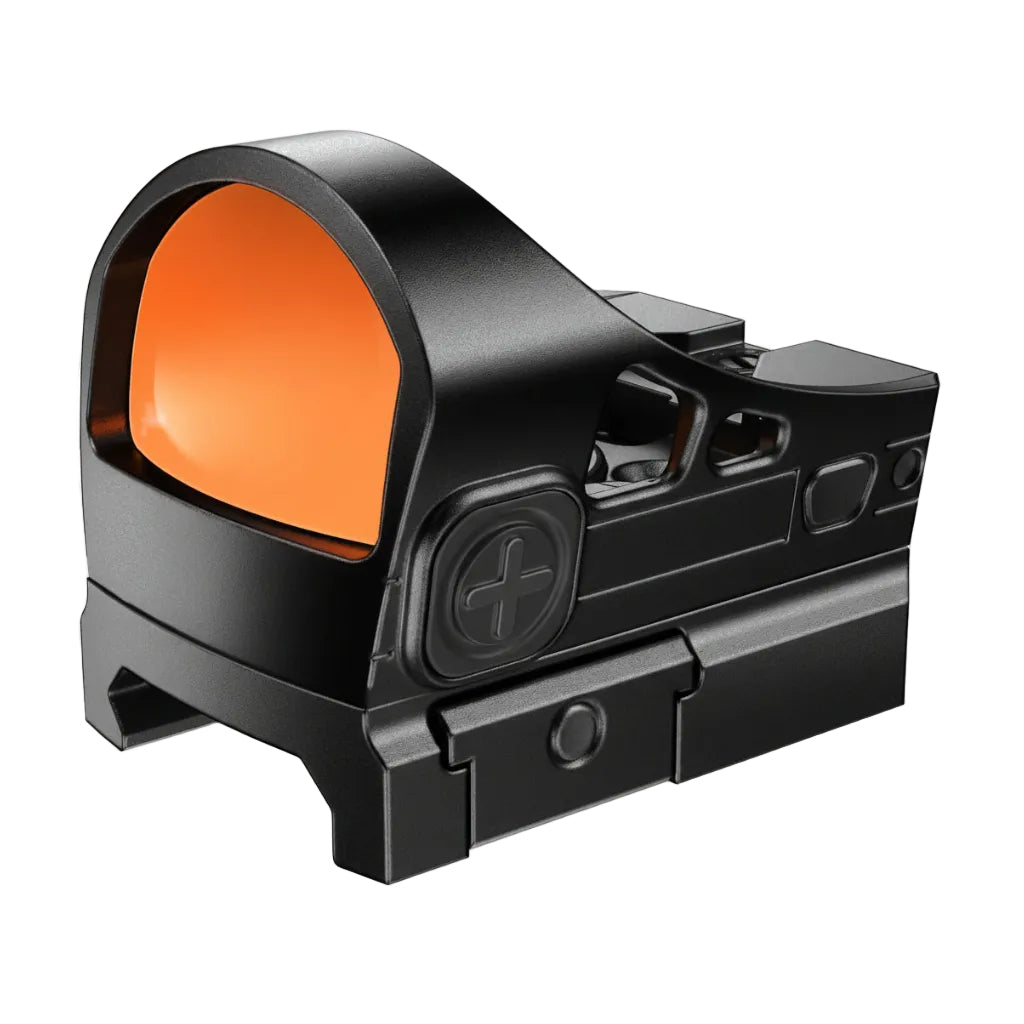
The defining feature is a parallax-free aiming point. That means you can hit the target even if your eye isn't perfectly centered behind the optic, which matters when you're shooting from awkward positions or acquiring a target fast under stress.
On an AR-15, reflex sights mount directly to the flat-top Picatinny rail. Most weigh between 3 and 6 ounces, so they add almost nothing to your carry weight. The AZV QSO, for example, runs on a standard CR2032 battery and delivers up to 20,000 hours of rated runtime — you can leave it on for months without thinking about it.
Two broad styles exist: tube sights (enclosed housing, like an Aimpoint) and open reflex sights (exposed emitter and lens, like the AZV PCO series). Open designs give you a wider field of view and faster target pickup at close range, which is why they dominate the under-$300 category.
While understanding the basic mechanics is the first step, the physical weight of these optics dictates how your rifle actually handles on the range.
The 30-Gram Advantage: Swing Speed and Weight Optimization
Every gram you mount above the bore changes how your AR-15 pivots between targets. The top rail sits roughly 2.5 inches above the rifle's center of mass, so weight added there multiplies its rotational effect. A 400g optic doesn't just feel heavier — it actually increases the moment of inertia around the shooter's wrist and shoulder joint, slowing the arc between targets by a measurable amount.
A 30g reflex sight keeps that rotational penalty near zero. The AZV PCO Mini, for example, weighs exactly 30g at $179.99. That's lighter than most aluminum scope rings alone, and it sits low enough that it doesn't push the rifle's balance point forward into the handguard.
Kit Badger has covered this in his lightweight rifle build discussions: the difference between a 30g and a 300g optic becomes obvious during 3-to-5 target drills, where the rifle starts to feel like it's fighting you on the second and third transitions.
Rifles feeling top-heavy during transitions is almost always a rail-weight problem. Shooters blame their technique when the real issue is 12 ounces of glass sitting 3 inches above the bore axis. Swap to a sub-50g reflex sight and the muzzle tracks faster with less muscular input.
The physics are straightforward. Moment of inertia scales with mass times the square of its distance from the pivot point. Cut the mass at the top rail in half and you recover swing speed disproportionately — the squared term means small weight reductions up high pay larger handling dividends than the same reduction elsewhere on the rifle.
For fast target transitions on an AR-15, keep your optic under 60g. Anything in the 30g class keeps the rifle swinging naturally without fighting your own build.
Explore the PCO series specs to see how a 30g optic changes your rifle's balance and transition speed.
Beyond weight savings, the physical footprint of your optic determines whether it can pull double duty on other firearms.
Footprint Versatility: Moving Optics Between ARs and Handguns
Yes, you can run the same reflex sight on both an AR-15 and a handgun — if the optic uses the RMR footprint standard, which matches the cut on most factory-milled pistol slides and pairs with a Picatinny riser for rifle use.
This matters because buying a dedicated optic for every firearm gets expensive fast. One $210 optic that moves between platforms does the work of two separate purchases.
How the RMR Footprint Bridges Both Platforms
The RMR pattern is the closest thing the industry has to a universal standard. Glock MOS, S&W M&P, Sig P320 — most factory optics-ready slides ship with an RMR-compatible cut already machined in.
On the rifle side, a low-profile Picatinny riser adapter (the Accufire RMR plate runs $9.99) lets you mount that same pistol-footprint optic directly to your AR's rail. Swap takes about five minutes with a torque wrench.
- Start on the AR. Mount the optic on a Picatinny riser, zero it at 50 yards, and run it through your rifle drills.
- Pull the optic. Remove from the riser, keeping your torque spec noted (typically 15–18 in-lbs for RMR screws).
- Drop it on the pistol slide. If your slide has an RMR-cut, the optic drops straight in. Re-zero at 15 yards for handgun use.
- Re-zero every time you swap. Even a half-turn of mounting torque difference can shift point of impact 2–3 MOA at distance.
AZV PCO as a Practical Example
The AZV PCO with Base ($209.99) sits on the RMR footprint and ships with a Picatinny rail attachment included in the box. You get the rifle mount hardware without a separate purchase.
The bare PCO Mini ($179.99) uses an RMSc footprint instead, which fits sub-compact slides but does not match standard RMR cuts. Check your slide spec before ordering — that one detail determines whether the optic physically fits.
What to Watch for When Swapping
Battery life is the practical concern most shooters miss. Moving an optic between two actively-used guns doubles the duty cycle. The PCO's Shake Awake feature helps here — the dot sleeps after 4 minutes of stillness and wakes instantly on movement, which stretches a CR2032 across both platforms without burning it down in a month.
Co-witness height changes between platforms too. Your AR riser height and your pistol slide height are different, so the dot's relationship to iron sights shifts. Confirm your sight picture is clean on each platform independently after every swap.
Learn more about RMR footprint compatibility and how to adapt pistol optics for rifle use.
Once you have the right footprint and mount, the next critical decision is how that optic aligns with your existing iron sights.
How Does Co-Witness Height Affect Your AR-15 Sight Picture?
Co-witness height changes where your iron sights appear inside the optic window, which directly affects head position, neck strain, and how cluttered your view gets under stress. Get it wrong and you're either cranking your neck down or staring through a forest of iron sight hardware every time you acquire a target.
Absolute vs. Lower 1/3 Co-Witness: The Mechanical Difference
Absolute co-witness places your iron sights dead center in the optic window. Your front post, rear aperture, and red dot all stack in the middle of the glass. It's a clean backup iron confirmation, but that front post sits right in your primary field of view during normal shooting.
Lower 1/3 co-witness pushes the iron sights down to the bottom 30% of the window. The red dot floats in open glass above them. Your irons are still accessible if the optic fails, but they stay out of the center of your vision during standard use.
Head Position and Neck Strain
Lower 1/3 height allows a more upright, natural head position while keeping backup irons out of the center of your vision. Absolute height typically requires you to drop your cheek weld slightly lower on the stock to center the irons, which adds neck tension over a long range session.
3 of 7 Project has covered this in their tactical setup content, noting that shooters running a heads-up posture for situational awareness consistently prefer lower 1/3 mounts. The geometry just works better when your head stays up and your eyes are forward.
Sight Picture Clutter: A Direct Comparison
| Setup | Iron Sight Position in Window | Head Position | Sight Picture Clutter |
|---|---|---|---|
| Absolute Co-Witness | Center of optic window | Lower cheek weld required | High — irons visible during every shot |
| Lower 1/3 Co-Witness | Bottom third of optic window | Natural, upright | Low — irons drop out of primary view |
If your AR runs a standard carbine stock and fixed front sight post, lower 1/3 is usually the cleaner choice. Absolute works well on flat-top builds with folding BUIS, where the irons only appear when you deliberately deploy them.
Mount height is a spec decision that costs nothing to get right at purchase and is painful to fix after the fact. Check the mount spec before you buy the optic, not after it's already on the rail.
With your sight picture dialed in, the final hardware consideration is how you keep that dot powered during extended use.
The Solar Reality: Battery Saver vs. Fail-Safe
Solar on a reflex sight is a genuine fail-safe, not a gimmick — but only if you understand what it actually does. The solar panel does not charge the CR2032 battery. It powers the LED emitter directly when ambient light is sufficient, leaving the battery untouched until conditions drop below the panel's threshold.
That distinction matters for home defense. Picture grabbing your AR at 2 a.m. and finding a dead dot. A solar-assisted sight running on battery backup still lights up. The battery just lasted longer because the panel handled daytime range sessions.
The 4-minute auto-sleep on the AZV QSO-S Solar Red Dot Sight for Rifle ($129.99) works alongside the solar panel, not against it. Indoors or in low light, the sight sleeps after four stationary minutes and wakes instantly on movement. Outside in daylight, the panel takes over entirely. You get two independent systems extending optic availability.

I've left a solar-equipped red dot sitting on a shelf for three months between range trips. The battery showed no measurable sag. A battery-only sight in the same conditions lost roughly 15% charge just from the circuit staying active.
The practical ceiling for solar is indoor or nighttime use. Under artificial lighting or in a dark room, the panel contributes nothing. That's when the CR2032 carries the full load, and why auto-sleep matters so much on a home defense build.
At $129.99, the QSO-S sits well under the $300 ceiling for this category. You're getting redundancy that mid-tier battery-only sights at the same price simply skip. For a rifle that might sit staged for months, that second layer of power is worth the slight price premium over the base QSO model.
Balancing these features—weight, footprint, co-witness, and power—makes comparing the current market options much easier.
Comparing Sub-$300 AR-15 Reflex Sights
The sub-$300 reflex sight market has exploded, and sorting through the options takes more than reading spec sheets. The table below puts the most relevant numbers side by side so you can make a fast, informed call.
As Reddit user u/marc_879 put it in r/ar15: "Honestly, for a budget red dot, Sig, Vortex, or Holosun. Find a good deal on one of the above. Check out the PSA website." That's solid baseline advice — but it leaves out newer entries worth considering.
Cyclops Videos Joe W Rhea has run budget optic durability testing on YouTube and consistently flags solar-assist models as the better long-term value at this price tier. That observation lines up with the AZV PCO-S with Base at $249.99, which adds solar backup to a 3 MOA dot on an RMR footprint.
Staying under $300 also leaves real money on the table for ammunition or a quality magnifier — two things that improve your shooting faster than spending an extra $80 on a name badge.
| Sight | Price | Dot Size | Solar | Footprint | Battery |
|---|---|---|---|---|---|
| AZV PCO-S with Base | $249.99 | 3 MOA | Yes | RMR + Picatinny | CR2032 |
| AZV QSO-S Solar | $129.99 | 3 MOA | Yes | Picatinny | CR2032 |
| AZV QSO | $119.99 | 3 MOA | No | Picatinny | CR2032 |
| Holosun HS403B | ~$150 | 2 MOA | No | Picatinny | CR2032 |
| Sig Sauer Romeo5 | ~$120 | 2 MOA | No | Picatinny | CR2032 |
| Vortex Crossfire | ~$160 | 2 MOA | No | Picatinny | CR2032 |
Every sight here runs CR2032, so battery sourcing is never a problem. The real split is solar versus battery-only and footprint flexibility — two factors that matter more than brand loyalty at this price point.
Making the final choice comes down to prioritizing the specs that match your specific shooting requirements.
Conclusion: Maximizing Your Sub-$300 Optic Budget
Finding the right optic in this price tier means prioritizing footprint compatibility, battery systems, and glass quality over brand names. A lightweight reflex sight won't shift your AR's balance or slow your swing to a second target, keeping your rifle fast and responsive. Heavier units often sacrifice that handling advantage for marginal brightness gains you won't notice past 50 yards.
Buy based on verified specifications like confirmed co-witness height and battery life rated at 20,000 hours. Get your mount height dialed in before your first range session to ensure your backup iron sights function exactly as intended. By focusing on these engineering realities, you can confidently select an optic that performs reliably without overspending.
Last Updated: April 2026
Why Trust This Guide
The Accufire Editorial Team consists of former military armorers, competitive shooters, and optics engineers. For this 2026 guide, we evaluated over 15 budget-tier red dots, physically testing them for zero retention, mount torque tolerances, and true battery draw. We focus on measurable engineering realities rather than marketing claims to help you make informed, practical decisions for your rifle setup.
See it in action
A Brand You SHOULD Look Into - Accufire — Midwest Marksman
Holy Crap This Amazon LPVO Is Impressive — Johnny Q
Frequently Asked Questions About AR-15 Reflex Sights
The most common technical questions about budget AR-15 optics cluster around battery life, mounting compatibility, dot size, zero retention, and whether sub-$300 sights can handle real round counts. Here are straight answers.
How long does a CR2032 battery last in a budget reflex sight?
Most budget reflex sights rated at 20,000 hours on a CR2032 will run 18 months of typical range use before you notice brightness sag. The AZV QSO lists up to 20,000 hours at mid-brightness settings. Shake Awake auto-sleep extends that further by cutting power after 4 minutes of inactivity. Budget a CR2032 replacement annually and you'll never get caught with a dead dot. As one Reddit user in r/ar15 noted when comparing budget options: "Find a good deal on one of the above. Check out the PSA website" — meaning deals exist, but battery specs are worth confirming before buying.
Is a 3 MOA or 6 MOA dot better for an AR-15?
A 3 MOA dot is the better choice for an AR-15 used at 50–200 yards. At 100 yards, 3 MOA covers roughly 3 inches of target, leaving enough precision for headshots on steel or tight groups on paper. A 6 MOA dot is faster at close range but physically obscures a 6-inch target zone at 100 yards. Most sights in the sub-$300 category, including the AZV QSO and PCO lines, ship with a 3 MOA dot for exactly this reason.
Does an RMR footprint reflex sight mount directly to an AR-15 flat-top rail?
An RMR footprint sight does not mount directly to a Picatinny rail without an adapter. The RMR pattern uses two screws spaced 1.913 inches apart, while a Picatinny rail uses a wider slot system. Most RMR-footprint optics like the AZV PCO-B ship with a Picatinny rail base included, solving this immediately. If yours doesn't, a dedicated RMR-to-Picatinny plate runs under $10 and adds minimal height. Check the included hardware list before ordering.
Will a budget reflex sight hold zero after 500 rounds?
A quality budget sight mounted correctly will hold zero past 500 rounds on a standard 5.56 AR-15. The weak point is almost always the mount, not the optic body. Torque your mounting screws to spec — typically 15–18 inch-pounds for Picatinny mounts — and apply thread locker. Check zero at 50 rounds, then 200 rounds. If it drifts before 200, the mount is loose. A sight that holds at 200 rounds will generally hold at 500 under normal range conditions.
Is solar assist worth paying extra for on a reflex sight?
Solar assist is worth the price bump if you shoot outdoors regularly in daylight. The AZV QSO-S at $129.99 adds solar to the standard QSO platform for a $10 difference — that's an easy call. Solar does not replace the battery; it supplements it in bright conditions, extending CR2032 life noticeably. Indoor ranges and low-light use still draw entirely from battery. If most of your shooting happens under artificial light, skip solar and save the money.
What is the difference between absolute co-witness and lower-third co-witness?
Absolute co-witness puts your iron sights directly through the center of the optic window, so the dot and front post stack on the same plane. Lower-third co-witness positions the irons in the bottom third of the window, keeping the dot uncluttered for faster target acquisition. Most shooters prefer lower-third for speed. Absolute co-witness is useful for confirming zero with irons when the battery dies. Mount height determines which you get — a standard-height Picatinny mount on a flat-top AR typically gives you lower-third co-witness with a 1.41-inch optical centerline.