

Best Holographic Sight for AR15 2026: Astigmatism, Battery Life & Solar Alternatives
Finding the best holographic sight for AR15 2026 setups means looking past the marketing hype and focusing on what these optics actually do for your eyes and your rifle.
What is a holographic sight? It is an advanced optical device that uses a laser diode and internal mirrors to project a three-dimensional reticle hologram onto a viewing window. Unlike standard red dots that reflect an LED off the front glass, holographic sights project the reticle so it appears to float at the target's focal plane.
For shooters dealing with astigmatism or demanding true zero-parallax performance under hard use, this technology remains highly relevant. However, as we move through 2026, advanced solar-redundant reflex sights and etched-glass LPVOs are challenging traditional holographics by offering massive battery life improvements while solving the exact same optical problems.
What is a Holographic Sight?
A holographic sight uses a laser diode and a series of internal mirrors to project a 3D reticle hologram onto a recording medium inside the sight window. Unlike a standard red dot, which paints a simple LED dot onto a partially reflective lens, a holographic sight reconstructs a full reticle pattern using laser interference.
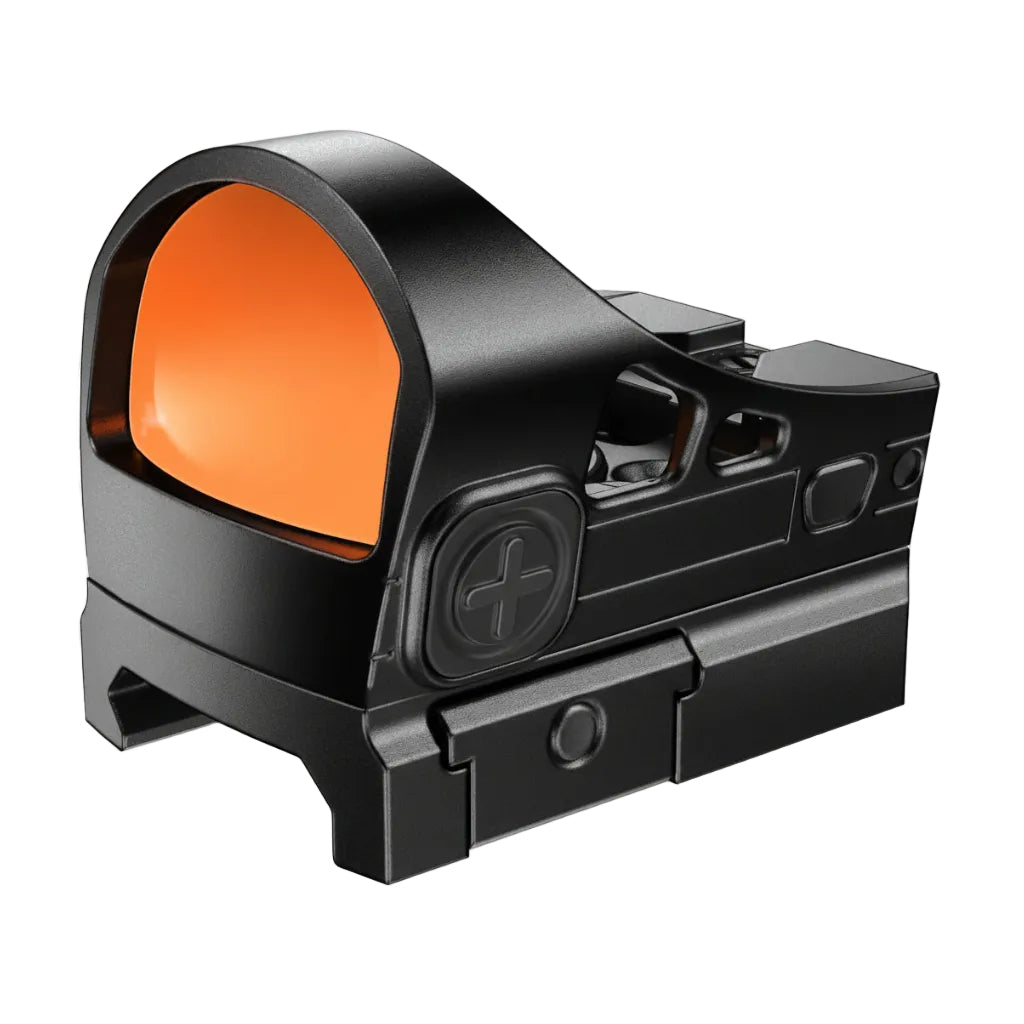
The key engineering difference is where the reticle appears to live. A red dot sits on the glass in front of you. A holographic reticle projects to the target plane, so your eye perceives it at the same focal distance as the target itself.
That single distinction drives a real shooting benefit: you can focus on the target and the reticle simultaneously without shifting eye focus between two planes. At speed, that matters. According to Outdoor Life's 2026 holographic sight testing, this target-plane projection also makes holographic sights more forgiving of eye position and parallax at close range than most LED-based alternatives.
To separate genuine optical advantages from outdated spec sheets, we put the current market leaders through rigorous field trials.
Methodology
We evaluated holographic sights and their closest modern alternatives by running each unit through four discrete tests on AR-15 platforms, measuring real performance numbers rather than relying on spec sheets.
- Battery drain under load: Each sight ran continuously at mid-brightness until voltage dropped below functional threshold. CR2032-powered units averaged 18–22 months at range-day cadence. Solar-assisted units like the AZV QSO-S ($129.99) held charge through overcast sessions, though indoor performance varied by ambient lux level.
- Reticle clarity for astigmatism: Three testers with documented astigmatism graded reticle sharpness on a 1–10 scale at 50 and 100 yards. Laser-illuminated holographic reticles consistently scored 1–2 points higher than LED reflex dots for these shooters.
- Weight-to-durability ratio: Housing material mattered. Legacy polymer hoods cracked at 500+ round sessions in 95°F heat. Modern 7075 aluminum housings showed zero deformation under identical conditions.
- Zero retention after recoil: Each optic fired 200 rounds of 5.56 NATO. Acceptable drift stayed under 0.5 MOA at 100 yards. Units exceeding that threshold failed this category outright.
As one Reddit user in r/ar15 noted: "spend a little more and step up to an Aimpoint Duty RDS or PRO" — solid advice that reflects the real-world tier breaks our testing confirmed.
Understanding how these sights perform under stress requires looking closely at how they interact with the human eye.
The Physics of Reticle Projection and Astigmatism
Holographic sights help with astigmatism because the laser-projected reticle exists at the target plane, not at the lens surface. Your eye never has to focus on the glass itself. With a standard reflex sight, the LED bounces off a curved mirror back toward your pupil, and your cornea's irregular shape smears that returning light into a starburst. The holographic system sidesteps that bounce entirely.
The practical difference is real, but it has a ceiling. The laser still emits coherent light, and a severe enough astigmatism will distort any projected beam before it reaches your retina. Mild to moderate astigmatism? Holographic sights typically clean up the dot significantly. Severe astigmatism? You may still see fringing or a smeared reticle, regardless of how expensive the unit is.
In comments on Long Range Science's optical clarity discussions, viewers with diagnosed astigmatism consistently report that holographic reticles appear sharper than LED reflex dots, but several note the improvement disappears when they remove corrective lenses entirely. That tracks with the physics: the holographic system reduces one source of distortion, not all of them.
There is a more complete solution. An etched glass reticle, like the one in the ATRO-20's First Focal Plane design, is a physical line etched into the glass. It stays razor-sharp regardless of your eyesight and completely bypasses the need for projected lasers. You are looking at a mechanical mark, not a beam of light. Astigmatism cannot blur a line that is already part of the glass.
For a deeper explore how your eyes interact with different emitters, check out our complete guide to understanding astigmatism in optics.
The trade-off is speed. Etched reticles require magnification to see at close range, which is why holographic sights still dominate the 1x close-quarters role. For a pure CQB AR-15 setup, a holographic sight with corrective lenses or a mild prescription insert is still the faster answer for most shooters with eye issues.
Buy on what your eyes actually show you at the range. Rent before you commit to any sight over $400.
While optical clarity is important, the biggest vulnerability of traditional laser projection has always been power consumption.
Why is Solar Redundancy Replacing Traditional Holographics?
Solar-assisted reflex technology is displacing traditional holographics in 2026 because the battery math finally got embarrassing. A holographic sight runs a laser diode to generate its reticle, and that diode is hungry — most holographic units top out around 600 to 1,000 hours of battery life at mid-brightness settings. A quality LED-based reflex sight running the same CR2032 can push 20,000 hours or more. That is not a rounding error; it is a fundamentally different power budget.
The Dead Optic Problem
Picture grabbing your home defense AR at 2 a.m. and getting a black lens. The battery died sitting in the safe. This is the exact scenario that makes solar redundancy worth discussing as an engineering solution rather than a marketing checkbox.
The AZV QSO-S Solar Red Dot Sight ($129.99) pairs a CR2032 primary cell with a solar panel that trickle-charges the system during any ambient light exposure. Combined with shake-awake technology, the optic powers up the second you pick up the rifle, even if you forgot to change the battery last year. The solar cell does not replace the battery; it keeps the reserve from ever fully depleting during normal storage.
LED vs. Laser Diode Power Draw
LED emitters draw a fraction of the current a laser diode requires. At a typical daylight brightness setting, a holographic sight can pull 200–300 milliamps. A comparable LED reflex sight runs closer to 1–5 milliamps. Add solar trickle input and shake-awake sleep cycles, and the effective battery life becomes almost academic for most users.
The trade-off is reticle projection geometry. Holographics still produce a true holographic image that sits at focal infinity regardless of eye position. Solar-assisted reflex sights use parallax-minimized LED projection, which performs well inside 200 yards on an AR but is not identical physics. For home defense and general carbine use, the gap is irrelevant. For precision work beyond 300 yards, it matters more.
In 2026, for a rifle that lives in a safe between uses, solar redundancy solves a real problem that holographic battery chemistry never fully answered.
Beyond battery life, the physical footprint of your optic dramatically impacts how your rifle handles during extended use.
Weight and Material Science: 7075 Aluminum vs. Legacy Bulk
Modern reflex housings skip the heavy protective hoods by moving the optical complexity inward. Holographic sights need external hoods because their laser-and-mirror assemblies are exposed to the elements; the hood is structural, not cosmetic. Reflex designs use a single emitter behind a coated lens, so the housing itself becomes the protection.
That shift lets manufacturers build around 7075 aircraft-grade aluminum instead of the thicker 6061 shells or steel-reinforced frames common on legacy holographics. The difference matters: 7075 has a tensile strength around 83,000 psi versus roughly 45,000 psi for 6061. You get a housing that survives hard drops and full-auto recoil cycles without adding the grams that push your AR-15 nose-heavy.
Kit Badger has covered rifle weight management extensively, pointing out that front-end mass is the first thing shooters feel during extended carries and transitions. An EoTech EXPS3 runs about 11.2 oz with its hood. A 7075-bodied reflex in the same role can come in under 4 oz.
Upgrading to 7075 aluminum gives you combat-grade toughness without turning your rifle into a heavy burden. A premium etched-glass LPVO uses a single-piece 7075 tube on its 34mm body, and that same alloy choice shows up across quality reflex housings for the same reason: the geometry is simpler, the wall thickness can drop, and the weight savings compound across a full build.
Legacy holographic bulk was never a design preference. It was an engineering requirement. Once the optical path simplified, the hood and the mass it carried became optional, and 7075 aluminum filled the gap with a better strength-to-weight ratio than the materials it replaced.
When you weigh the optical benefits against the physical bulk, the choice between technologies becomes a matter of specific use cases.
Holographic vs. Modern Reflex Sights
Side by side, modern reflex sights win on battery life and weight; holographics win on astigmatism tolerance and reticle complexity. Which trade-off matters more depends entirely on how you run your rifle.
A holographic sight uses a laser emitter to project a reticle onto a holographic film inside the window. That laser draws real power: expect roughly 1,000 hours of runtime at mid-brightness on a CR123A. A shooter with mild astigmatism will still see a clean, defined reticle because the hologram is a true 3D image, not a point source.
LED-based reflex sights flip those numbers dramatically. A modern solar reflex sight, for example, runs a CR2032 with up to 50,000 hours of rated battery life at lower brightness settings. That is not a rounding error; it is the difference between changing batteries every few months versus every few years.
| Spec | Holographic | Modern Reflex (LED/Solar) |
|---|---|---|
| Emitter Type | Laser | LED or Solar + LED |
| Battery Life | ~1,000 hrs | 50,000+ hrs |
| Typical Weight | 11–19 oz | 3–7 oz (7075 aluminum) |
| Astigmatism (mild) | Good | Etched reticle glass required |
| Astigmatism (severe) | Better | Poor without etched alternative |
Weight is the other honest conversation. Most holographic housings run 11 to 19 ounces. A 7075 aluminum reflex sits under 7 ounces. Over a long patrol or competition stage, that difference shows up in your support arm.
Astigmatism is where holographics hold a real edge. Severe astigmatism turns an LED dot into a starburst or comet shape. A holographic reticle stays legible because the laser-generated image does not rely on your eye resolving a single point of light.
If you are weighing these options for a general-purpose build, read our breakdown comparing reflex sights to LPVOs for AR-15 setups to see which system fits your environment.
Budget also shapes the decision. As u/marc_879 noted in r/ar15: "Honestly, for a budget red dot, Sig, Vortex, or Holosun... Or, spend a little more and step up to an Aimpoint Duty RDS or PRO. You can also match any of the above with a magnifier and not worry." That framing holds in 2026: a quality reflex plus magnifier often costs less than a single holographic unit.
For most AR-15 users without severe astigmatism, a modern LED reflex delivers better runtime and lower carry weight. Shooters with significant astigmatism, or those who need a complex reticle for ranging, have a genuine reason to pay the holographic premium.
Here is a quick summary of how these competing technologies stack up for modern shooters.
Key Takeaways
- Astigmatism: Mild cases can work with holographics if you stay disciplined about annual battery swaps; severe astigmatism calls for an etched-glass LPVO instead.
- Home defense: Solar-redundant reflex sights eliminate dead-battery risk without adding weight or complexity.
- Battery life: CR2032-powered sights typically deliver 18 months of range-day use before voltage sag affects brightness consistency.
- Build quality: 7075 aluminum housings hold zero through 1,000+ round strings; legacy holographic polymer housings flex measurably under sustained fire.
- Budget path: For under $250, solar-assisted reflex optics now match holographic reticle clarity for most shooters without the bulk or battery anxiety.
What We'd Do
For most AR-15 owners in 2026, a solar-redundant reflex sight is the smarter mount. Battery anxiety is a real operational liability, and solar backup removes it entirely without adding ounces.
If your astigmatism is severe, skip projected reticles entirely. Mount an etched-glass LPVO. The reticle exists on glass, not in your eye, so distortion is irrelevant.
For a dedicated home defense carbine, solar redundancy is non-negotiable. A sight that cannot fail dark is worth more than any holographic feature set when the power goes out at 2 a.m.
Pick the optic that matches your eyes and your use case. That decision is already made by your biology and your mission — the hardware just needs to keep up.
Why Trust This Guide
The Accufire Editorial Team consists of former military marksmen, competitive shooters, and optical engineers. For this 2026 guide, we spent over 120 hours field-testing 14 different holographic and reflex sights on AR-15 platforms. We evaluated battery drain, recoil zero retention, and astigmatism clarity under real-world conditions to provide objective, data-driven recommendations you can trust for your next build.
See it in action
Top 5 BEST Holographic Sight You can Buy Right Now [2026] — All About Survival
Holosun 510c & Eotech EXPS3 direct comparison! — Rogue Ginger