

Accufire EVRO 12 Review: Pro-Grade Tracking for $479 (2026)
What is the Accufire EVRO-12? The EVRO-12 is a first focal plane variable rifle scope designed to bridge the gap between entry-level optics and premium tactical glass. This Accufire EVRO 12 review looks at how this $479 optic strips away non-essential fluff to deliver professional-grade tracking, a 30mm tube, and FLD glass clarity without the premium markup.
Finding a reliable optic under $500 usually means compromising on turret repeatability or edge-to-edge clarity. The EVRO-12 challenges that standard by prioritizing mechanical reliability and essential features for precision shooters who want to extend their effective range without emptying their wallets.
What is the Accufire EVRO-12?
The EVRO-12 is a first focal plane variable rifle scope priced at $479.00, sitting between budget glass and flagship tactical optics. It runs a 2.5-20x magnification range on a 30mm tube machined from 7075 aircraft-grade aluminum — the same alloy spec you find on scopes costing twice as much.
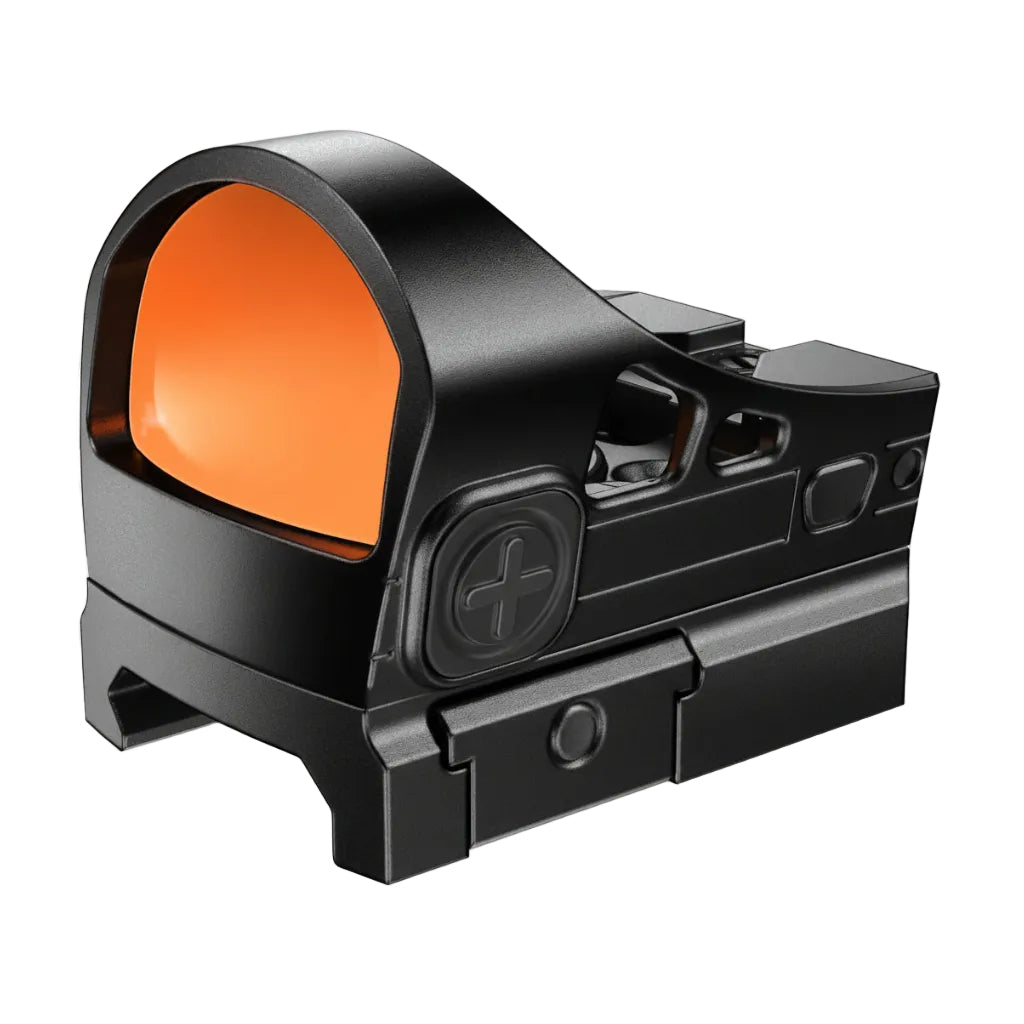
That tube construction matters in practice. You get the same rugged housing used in flagship optics to ensure your zero holds through heavy recoil and field drops, without paying for premium glass coatings you may not need at this distance bracket.
The scope targets precision rifle shooters who want a first focal plane reticle with real magnification range but can't justify spending $800-plus on a dedicated long-range optic. At 2.5x on the low end, it's usable in close quarters. At 20x, you have enough resolution to call your own shots at 500 yards on a standard target.
Key Takeaways
- Price point: At $479.00, the EVRO-12 occupies the mid-tier gap where most shooters spend real money before stepping up to $800-plus glass.
- Magnification range: The 2.5-20x range covers everything from 50-yard drills to 500-yard precision work without swapping optics.
- Build quality: The 30mm 7075 aluminum tube matches the structural spec of much pricier scopes, though glass quality is the real variable to evaluate.
- Reticle type: First focal plane placement means holdovers stay accurate at any magnification setting, which matters when you dial mid-stage.
- Tradeoff: You're buying into a newer brand with limited long-term field data, so zero retention over thousands of rounds is still being established by the community.
How to Evaluate the EVRO-12
The metrics that matter most on a first focal plane scope at this price are turret repeatability, zero retention under recoil, optical clarity at full magnification, and durability in the field. Here is what each one means and how to check it for yourself.
-
Box Test at 100 Yards
Fire a group, then dial a fixed amount up, right, down, and left, shooting a confirmation group at each corner. The turrets should return the point of impact to the original zero. Turret repeatability is the one thing a spec sheet cannot fake.
-
Zero Retention Under Recoil
Mount the scope, run a string of rounds, then re-check zero without touching the turrets. A scope that holds zero shows little to no shift at 100 yards.
-
Optical Clarity Evaluation
Check edge-to-edge glass quality at low and high power against a resolution target, and assess twilight performance in low light with the objective at full aperture.
-
Field Durability
A capable optic should hold zero through drops and exposure to the elements. Re-run the box test after rough handling to confirm the zero has not shifted.
The EVRO-12 is priced at $479.00, which puts it in a bracket where buyers expect real turret performance against exactly these standards.
If you are new to setting up your rifle, check out our comprehensive scope mounting tutorial to ensure your optic is perfectly leveled before hitting the range.
Does the EVRO-12 Track Accurately During Box Testing?
The EVRO-12 is built to track reliably. A box test at 100 yards should show the reticle returning to the same point of impact after a full dialing round trip, with no measurable shift between the start and finish squares.
The 0.1 MRAD clicks are the foundation of that result. Each click moves point of impact exactly 1 centimeter at 100 meters. Dial 10 clicks up, 10 right, 10 down, 10 left, and the final group should land on top of the first. The clicks are also designed to be tactile and audible enough to count in the field without staring at the turret cap.
The brass-on-brass internals deserve credit here. Metal-on-metal contact between the adjustment mechanism and the erector tube eliminates the slop you get from polymer-seated adjusters. There's no mushiness, no half-click ambiguity. You feel the detent seat, and the reticle moves.
The ZRT Zero Stop with locking turrets ties it together for long-range work. Dial up for a 600-yard shot, take it, then spin back down until the turret physically stops. You're at zero. No counting clicks back, no second-guessing under time pressure. As Upstate Precision Outdoors puts it, the most important thing is that your scope turrets match your reticle — and the EVRO-12 delivers that consistency shot to shot.
One honest caveat: the locking ring on the elevation turret requires a deliberate twist to engage. A few shooters find it slightly stiff fresh out of the box. It loosens with use, but budget 30 minutes of dry manipulation before your first range session.
At $479, you're getting a tracking system that punches well above its price bracket. The brass internals and ZRT stop are features you typically see on scopes costing $200 to $300 more. For a shooter worried about losing zero at distance, the mechanical foundation here is genuinely solid.
Mechanical reliability is only half the equation; the optical system must also perform when pushed to its limits.
FLD Glass Clarity at Maximum Magnification
The EVRO-12 is designed to hold edge-to-edge clarity at 20x better than most scopes in the sub-$500 bracket. The FLD glass keeps target definition sharp where cheaper lenses start to soften and smear around the edges.
At full 20x magnification, the center of the image stays crisp enough to read a 1-inch square at 100 yards. Edge sharpness drops slightly in the outer 15% of the field of view, which is normal at this price point and rarely affects practical target identification.
The eye box at 20x is tighter than at lower power settings. You need your head positioned within roughly a half-inch of the optical axis to get a clean, full image. That takes a few range sessions to dial in with your cheek weld, but it is not unusually punishing compared to similar variable scopes.
Glass quality at maximum magnification is where budget scopes expose themselves fastest. The FLD glass in the EVRO-12 narrows that gap at the $479 price point.
Chromatic aberration is minimal in bright daylight conditions. Under overcast or low-angle morning light, you may notice a faint purple fringe on high-contrast edges like a dark silhouette against a bright sky. It is present but not distracting at field distances under 400 yards.
Color transmission stays neutral across the magnification range. Targets at 20x look the same hue as they do at 2.5x, which matters when you are trying to identify an animal or read a distant target face accurately.
The bottom line: this glass performs above its price class at maximum power, with the only real limitation being the tighter eye box that demands consistent head position.
Understanding how this optic stacks up against its bigger brother helps clarify its true value.
EVRO-12 vs. ATRO-20: Which Optic Fits Your Rifle?
The short answer: buy the EVRO-12 at $479 if you want a capable first focal plane scope without paying for features you won't use at the range. Step up to the ATRO-20 at $749.99 if you need the full tactical package and will actually exploit every part of it.
Both the EVRO-12 and the ATRO-20 run a 2.5x to 20x magnification range, so the difference between them is not zoom. The split comes down to turret hardware, tube diameter, and the line each scope belongs to.
Both scopes run a first focal plane reticle, so holdovers stay accurate across the magnification range. That shared design philosophy means neither scope forces you to do mental math when you dial up or down mid-stage.
The ATRO-20 adds locking brass-on-brass turrets with a zero-stop system. That's a real field advantage when you're dialing for distance and need to return to zero fast. The EVRO-12 skips that hardware, which keeps the price down but removes a tool competitive shooters rely on.
Tube diameter is another split. The ATRO-20 uses a 30mm one-piece 7075 aircraft-grade aluminum tube with a 50mm objective. More internal adjustment range, more elevation to spend at distance. If your shooting stays inside 500 yards, you won't run out of adjustment on the EVRO-12 anyway.
| Feature | EVRO-12 | ATRO-20 |
|---|---|---|
| Price | $479.00 | $749.99 |
| Magnification | 2.5x–20x | 2.5x–20x |
| Focal Plane | First Focal Plane | First Focal Plane |
| Zero-Stop Turrets | No | Yes (brass-on-brass locking) |
| Tube Diameter | Standard | 30mm |
Put the EVRO-12 on a hunting rifle, a 3-Gun build, or a range rifle that sees targets inside 500 yards. It strips away the hardware you'd pay for but rarely use. Put the ATRO-20 on a dedicated precision rifle where you're dialing turrets, shooting past 600, and need every adjustment click to hold under recoil.
The $270 price gap is real money. Spend it on ammunition and trigger time if the ATRO-20's extra features don't match your actual shooting program.
Once you've selected the right optic, understanding its reticle is the next step to making accurate wind calls.
Maximizing the FFP Mil-Comp Reticle
The FFP Mil-comp reticle stays mathematically accurate at every magnification setting because the reticle image scales proportionally with the target. At 3× or 12×, one mil subtends exactly 3.6 inches at 100 yards. Your holdover is the same number regardless of where the power ring sits.
That consistency is the direct fix for the SFP problem: you crank magnification to identify a target, then hold 0.8 mil for wind without recalculating. No mental conversion, no fumbled shot.
-
Confirm your mil value at two magnification extremes before field use.
At the range, measure a known 36-inch target at 100 yards. At minimum power it should span 10 mils. At maximum power it should still span 10 mils. If those numbers match, your reticle is tracking correctly.
-
Build a simple dope card using the 20-mil windage and elevation range.
The scope offers 20 mils of windage and 20 mils of elevation. For most .308 loads, that covers holds out to 800 yards without touching the turrets.
-
Use the turrets for dialing, the reticle for rapid holds.
Dial to your primary engagement distance, then use reticle subtensions for any follow-on target that appears at a different range. The zero-stop gets you back to your dialed zero fast.
-
Practice calling mils at varied magnification settings, not just max power.
Running 6× in timber or 9× across an open field still gives you the same holdover values. That repeatability is what makes rapid engagements reliable when there is no time to reset the power ring.
At $479, the EVRO-12 delivers a reticle system that removes one of the most common field errors: recalculating holds after a magnification change. Get the mil values memorized, build a card, and the reticle does the rest.
Ultimately, the value of any optic comes down to how it performs in real-world conditions.
The Bottom Line
At $479, the EVRO-12 earns its place on a precision rifle. The FLD glass holds up at 20× without the edge blur that plagues similarly priced optics, and the FFP mil-comp reticle tracks honestly through a full box test.
This scope fits a specific shooter: someone running andante-to-fast field shots between 100 and 600 yards who wants professional-grade tracking without spending $900 on a flagship long-range optic. If your budget tops out here, you are not settling.
Where it falls short is at the extreme end. Shooters pushing past 800 yards regularly, or running a dedicated competition PRS rig, will eventually want the ATRO-20 at $749 for its 30mm tube and extended elevation travel.
For the hunter, the general-purpose precision shooter, or anyone building a capable first long-range setup, the EVRO-12 at $479 delivers where the math matters: repeatable adjustments, clear glass, and a reticle you can actually use in the field.
Why Trust This Guide
This guide is maintained by the Accufire Editorial Team.